12.09.2008

Illinois: “Land of Greased Palms”

Illinois has long legacy of public corruption - At least 79 elected officials have been convicted of wrongdoing since 1972

Excerpt:

The state, Cook County and its governmental seat, Chicago, have a long history of corruption by elected and appointed officials.

The culture of corruption dates back to the late 19th century, when a gambling-house owner named Michael Cassius McDonald created the city's first political machine, establishing a model in which officials would distribute contracts, jobs and social services in exchange for political support, according to a scholarly history of organized crime in Chicago by Robert Lombardo, a sociology professor and former Chicago and Cook County police officer.

Its persistence was documented in Sept. 7, 2006 by the Chicago Sun-Times, which reported that at least 79 current or former Illinois, Chicago or Cook County elected officials had been found guilty of a crime by judges, juries or their own pleas since 1972. The paper provided this tally of the tarnished: three governors, two other state officials, 15 state legislators, two congressmen, one mayor, three other city officials, 27 aldermen, 19 Cook County judges and seven other Cook County officials.

The article noted that so many aldermen had been jailed that the newspaper ran a front-page-story in 1991 when the year passed with none being indicted or convicted.

The ranks of imprisoned pols include three former Illinois governors — George Ryan, Dan Walker and Otto Kerner Jr.

Ryan, a rare Republican in the heavily Democratic state and Gov. Rod Blagojevich’s predecessor, is serving a six-year prison sentence after being convicted in April 2006 on racketeering and fraud charges. A decade-long investigation began with the sale of driver's licenses for bribes and led to the conviction of dozens of people who worked for Ryan when he was secretary of state and governor.


Illinois Governor in Corruption Scandal


Excerpt:

Mr. Blagojevich, a Democrat, called his sole authority to name Mr. Obama’s successor “golden,” and he sought to parlay it into a job as an ambassador or secretary of Health and Human Services, or a high-paying position at a nonprofit or an organization connected to labor unions, prosecutors said.

He also suggested, they said, that in exchange for the Senate appointment, his wife could be placed on corporate boards where she might earn as much as $150,000 a year, and he tried to gain promises of money for his campaign fund.

If Mr. Blagojevich could not secure a deal to his liking, prosecutors said, he was willing to appoint himself.

“If I don’t get what I want and I’m not satisfied with it, then I’ll just take the Senate seat myself,” the governor said in recorded conversation, prosecutors said.


Comment: One has to wonder how much Barak Obama knew about the plan to sell his Senate seat. Update: Obama: No contact with Blagojevich on Senate seat

Update 2: Or did he? Questions Arise About the Obama/Blagojevich Relationship

But on November 23, 2008, his senior adviser David Axelrod appeared on Fox News Chicago and said something quite different.

While insisting that the President-elect had not expressed a favorite to replace him, and his inclination was to avoid being a "kingmaker," Axelrod said, "I know he's talked to the governor and there are a whole range of names many of which have surfaced, and I think he has a fondness for a lot of them."

...

There are no allegations that President-elect Obama or anyone close to him had anything to do with any of the crimes Gov. Blagojevich is accused of having committed.

In fact, there are indications that Mr. Obama and his team refused to go along with the "pay to play" way Blagojevich is accused of operating, offering only "gratitude" if the governor appointed his friend Valerie Jarrett to take his U.S. Senate seat, much to the governor's chagrin.

But there remain questions about how Blagojevich knew that Mr. Obama was not willing to give him anything in exchange for the Senate seat -- with whom was Blagojevich speaking? Did that person report the governor to the authorities?

And, it should be pointed out, Mr. Obama has a relationship with Mr. Blagojevich, having not only endorsed Blagojevich in 2002 and 2006, but having served as a top adviser to the Illinois governor in his first 2002 run for the state house.

That 2002 endorsement came at the same time that Axelrod had such serious concerns about whether Blagojevich was ready for governing he refused to work for his one-time client.

12.08.2008

A call to personal responsibility and market forces

Getting Out of the Credit Mess - The last thing we need is policy that encourages or incurs more debt

Excerpt:

The intellectual start of this mess was in a flawed Boston Federal Reserve study published in 1992 that purported to show that minorities were treated less well than whites. That study led to increased political pressure on banks to modify their standards with increased emphasis through the Community Reinvestment Act, and aided by U.S. Department of Housing and Urban Development regulations in the Clinton administration that required parity of outcomes in the lending process.

The effect of all of this meddling was compounded by the lax or incompetent supervision of Fannie Mae and Freddie Mac. All in all, the government got into the business of encouraging and then forcing lending institutions to make mortgage loans to people who could not pay them back. What we ended up with is a failure of government, which we have erroneously termed a failure of capitalism.

...

All of this led to a huge overleveraging in the consumer market. The increase in debt burden fueled much of the nation's economic growth over recent decades, aided somewhat by increases in productivity and underpinned by easy money from the Federal Reserve. Since consumers represent about 70% of the nation's GNP, and since leverage cannot increase forever, we were bound to see the bubble burst and eventually enter a substantial recession.

So, are the current credit easing actions likely to be helpful or not? In my judgment, measures to create liquidity are likely to be helpful. Financial institutions that lend money to credit-worthy people for reasonable purposes have experienced a substantial reduction in available funding from which they can make loans. Hence the programs to support the securitization markets are sensible because money used for this purpose will be lent and used for purchases. Programs that deliver a short-term reduction in mortgage rates will, at the margin, help absorb some of the available housing stock, reducing the time it will take for housing to reach market-clearing levels.

...

In the longer term, our nation must delever -- either by reducing the amounts of borrowing or by increasing consumer earning power through economic growth. Relying on growth alone implies a growth rate higher than we have ever experienced in our nation's history. Nonetheless, our public policy must encourage economic growth by lowering tax rates for corporations and individuals while at the same time avoiding what would be growth killers, including "card check" legislation and trade restrictions. Public policy should support higher savings rates, and avoid encouraging increased consumer spending funded by further debt, which may be helpful in the short term but catastrophic in the longer term.

It is not only consumers that must delever. Governments must as well. State and local governments across the nation have incurred direct and indirect debt or obligations in the tens of trillions of dollars -- obligations that cannot be met under any set of reasonable circumstances without an explosion in growth and tax revenues. In fact, we continue to incur debt for politically palatable ideas, like rebate checks, which have very little stimulative power but increase the depth of the hole we're in.

To solve this problem for ourselves and future generations, we must get back to our historic reliance on personal responsibility and market forces, and get government out of economic management. It doesn't do a good job, as the current economic mess amply proves.


Comment: The last paragraph is key - "personal responsibility and market forces, and get government out of economic management"

My right foot

This will boggle your mind and you will keep you trying over and over again to see if you can outsmart your foot, but, you can't.

It's pre-programmed in your brain!


  1. Without anyone watching you (they will think you are GOOFY......) and while sitting at your desk in front of your computer, lift your right foot off the floor and make clockwise circles.
  2. Now, while doing this, draw the number '6' in the air with your right hand. Your foot will change direction.


I told you so!!! And there's nothing you can do about it! You and I both know how stupid it is, but before the day is done you are going to try it again, if you've not already done so.

Send it to your friends to frustrate them too!


Comment: Sent to me by my Sister-in-law.

12.07.2008

Skater goes through ice on Medicine Lake

Skater falls through ice of Medicine Lake

Excerpt:

A skater who fell through thin ice was pulled from Medicine Lake in Plymouth Sunday and rushed to North Memorial Medical Center in Robbinsdale.

The man was found in the water about 3 p.m. after another skater spotted a hat floating in the water and called police at 1:50 p.m., the Hennepin County Sheriff's Water Patrol reported.

When pulled from the water, the man had no pulse and was not responsive to resuscitation attempts, but authorities offered no more information about his condition Sunday evening.

Water Patrol personnel found him about 600 yards from shore, said Sgt. Chris Mathisen of the Sheriff's Department.

The man was wearing ice skates and had a camera around his neck, Mathisen said.

The victim, who authorities believe was visiting from out of town, has not been identified pending notification of relatives.

The area where he was skating, near French Regional Park off Rockford Road, had been open water on Saturday and froze overnight, Mathisen said.


Comment: We saw the news trucks there this afternoon. This is the same area of the lake where 2 trucks went through in February 2007. Trucks through thin ice

What if worship were like the NFL?


HT: The Irish Calvinist


Comment: I'm glad it's not!

Ratings Agencies - just profit-maximization entities?

Debt Watchdogs: Tamed or Caught Napping?

Excerpts:

“The mistaken notion that Moody’s was a company like any other, that was very fundamental,” said Sylvain Raynes, a former Moody’s analyst who is co-founder of R&R Consulting, a firm that helps investors gauge debt risks. “It is not just a profit-maximization entity like Exxon or Microsoft. Moody’s has a duty to the American public. People trusted it.”


Comment: Rating agencies and area of specialty


There are two superpowers in the world today in my opinion. There's the United States and there's Moody's Bond Rating Service. The United States can destroy you by dropping bombs, and Moody's can destroy you by downgrading your bonds. And believe me, it's not clear sometimes who's more powerful. (Thomas Friedman. From Feb. 13, 1996 interview with Jim Lehrer.)

12.06.2008

Obama's 21st Century New Deal

Obama Pledges Massive Public Works Program

Excerpts:

“We need action — and action now,” he said in an address taped for broadcast Saturday morning on radio and YouTube.

...

Mr. Obama and his team are working with Congressional leaders to fashion a spending package that could invest hundreds of billions of dollars into the economy. A big part of that would be infrastructure projects such as building or repairing roads, bridges, schools, sewer systems and other public utilities. Democrats hope the new Congress that takes office in early January could pass such a measure in time for Mr. Obama to sign almost instantly after taking office Jan. 20.

The president-elect in his Saturday address offered some general ideas of what he wants to see in the package. Besides public works construction, he promised to make government buildings more energy efficient, modernize school classrooms and libraries with computers, expand access to broadband Internet service and upgrade information technology in hospitals and doctors’ offices.

The big ticket will be the public works spending. “We will create millions of jobs by making the single largest new investment in our national infrastructure since the creation of the federal highway system in the 1950s,” Mr. Obama said.

He did not give any estimate of how much he would devote to that purpose, but when he met with the nation’s governors this week, they said the states had $136 billion worth of already-approved road, bridge and other projects ready to go as soon as funding became available. They estimated each billion dollars spent would create 40,000 jobs.

By invoking the federal interstate program, Mr. Obama sought to summon the spirit of Dwight D. Eisenhower, who launched the highway construction that became integral to the nation’s economic development. That imagery seemed intended to respond to critics, who argue that public works spending historically has not been a reliable catalyst for short-term economic growth and instead is more about politicians gaining points with constituents.


Comment: Sounds nice on the surface. But probably will just spend us into more debt.

Updated: (plus changed the title of the blog to reflect politico.com article)

Obama unveils 21st Century New Deal

North Dakota is hiring

North Dakota Asks, What Recession?

Excerpts:

North Dakota’s cheery circumstance — which economic analysts are quick to warn is showing clear signs that it, too, may be in jeopardy — can be explained by an odd collection of factors: a recent surge in oil production that catapulted the state to fifth-largest producer in the nation; a mostly strong year for farmers (agriculture is the state’s biggest business); and a conservative, steady, never-fancy culture that has nurtured fewer sudden booms of wealth like those seen elsewhere (“Our banks don’t do those goofy loans,” Mr. Theel said) and also fewer tumultuous slumps.

As it happens, one of the state’s biggest worries right now is precisely the reverse of most other states: North Dakota has about 13,000 unfilled jobs and is struggling to find people to take them.

...

“Our problem is that everybody thinks that it’s a cold, miserable place to live,” said Bob Stenehjem, a Republican and the State Senate’s majority leader. “They’re wrong, of course. But North Dakota is a pretty well-kept secret.”

With 635,867 residents, North Dakota is among the least populous states, and, in the past few years, more people have moved away, census figures show, than have moved here.

Katie Hasbargen, a spokeswoman for Microsoft’s Fargo campus, which is in the middle of a $70 million or so building expansion and is, even now, looking for a few additions to its work force (of more than 1,500), said false perceptions of the state are the problem when it comes to recruiting workers. “The movie,” Ms. Hasbargen said, referring to the 1996 Coen brothers’ film that bears this city’s name, “didn’t do us a lot of favors.”


Comment: But it is North Dakota! Re: "everybody thinks that it’s a cold, miserable place to live" - they're right!

Job's report: “horrendous"

Grim Job Report Not Showing Full Picture

Excerpts:

The number of people out of the labor force — meaning that they were neither working nor looking for work and that the government did not consider them unemployed — jumped by 637,000 last month, the Labor Department said. The number of part-time workers who said they wanted full-time work — all counted as fully employed — rose by an additional 621,000.

Take these people into account, and the job market may be in its worst condition since the early 1980s. It is still deteriorating rapidly, too.

Already, the share of men older than 20 with jobs was at its lowest point last month since 1983, and very close to the low point of the last 60 years. The share of women with jobs is lower than it was eight years ago, which never happened in previous decades.

...

Even Wall Street economists, whose analysis usually comes shaded in rose, seemed taken aback by the report. Goldman Sachs called the new numbers “horrendous.” Others said “dreadful” and “almost indescribably terrible.” In a note to clients, Morgan Stanley economists wrote, “Quite simply, there was nothing good in this report.” HSBC forecasters said they now expected the Federal Reserve to reduce its benchmark interest rate all the way to zero.

Such language may sound out of step with a jobless rate that, despite its recent rise, remains at 6.7 percent; the rate exceeded 10 percent in the early 1980s. But over the last few decades, the jobless rate has become a significantly less useful measure of the country’s economic health.

That is because far more people than in the past fall into the gray area of the labor market — not having a job and not looking for one, but interested in working. This group includes many former factory workers who have been unable to find new work that pays nearly as well and are unwilling to accept a job that pays much less. Some get by with help from disability payments, while others rely on their spouses’ paychecks.


U.S. Job Losses Signal Recession Will Be Long, Deep

Employers cut payrolls last month at the fastest pace in 34 years as the unemployment rate rose to 6.7 percent, the highest level since 1993. The 533,000 drop brought cumulative job losses this year to 1.91 million, the Labor Department said yesterday in Washington.

“Almost all businesses are in survival mode, and they’re slashing payrolls and investments just to conserve cash,” Mark Zandi, chief economist at Moody’s Economy.com in West Chester, Pennsylvania, said in a Bloomberg Television interview yesterday. “We’re in store for some big job losses.”


Comment: First of three economic posts today. My own company (unnamed by policy) has a hiring freeze. One of my kids is out of work (but has a part time job - was his 2nd job). For the first time in my life, I know personally probably at least a dozen who are out of work or soon will be.

12.05.2008

Cars designed in DC won't sell

Bridge Loan to Nowhere - Congress and business 'viability' rarely mix.

Excerpts:

All three restructuring plans are heavy on promises to build the "green" cars that a Democratic Congress wants built. GM promises 15 hybrid models by 2012 and 37 miles per gallon on average for its cars. Chrysler commits to putting flex-fuel engines, which can run on ethanol or gasoline, in half of its cars. Ford promises to save 16 billion gallons of gas by using "advanced technology" and to invest $14 billion to improve fuel efficiency.

...
This is not a bailout that Congress is debating. It is a federal takeover. We don't mean that in the sense that the feds will own the companies on paper, although that can't be ruled out. What Congress wants to own is their business plan, and Detroit seems prepared to oblige.

...
The core problem is that the companies can't pay their creditors in fuel-economy standards. Two economists testified that the ultimate cost of this bailout would certainly be much, much higher than $34 billion. Mark Zandi of economy.com put the number at up to $125 billion -- and he supports the bailout. NYU's Edward Altman said the company proposals were "doomed to fail." He proposed a prepackaged bankruptcy for GM and Chrysler, with the government providing the debtor-in-possession financing if necessary. His point, which ought to be sobering, was that outside of bankruptcy there is no way to make these taxpayer loans senior to existing secured debt -- meaning the government might never get paid back if the companies go bankrupt later.

...
The car makers' request for a bridge loan, by contrast, looks like a $34 billion bridge to nowhere. It has already morphed into an opportunity for political extortion -- and we don't even have a bill yet. When, in a couple years, costs have not come down as expected because of political pressure to keep the unions happy and the green cars aren't selling -- because they were designed in Washington, not for consumers -- the companies will be back for more money.

The bailout commitment, in other words, is effectively open-ended, no matter what anyone says. And with the feds so invested in the companies, it will only be a short step for Congress to begin to coerce consumers to buy the cars that Washington prefers. Mr. Friedman, the concerned scientist, is already planning for that day. He said Friday that we'll eventually have to impose a "fee" (read: tax) on cars that "pollute too much" or use "too much gas."

This fairy tale, in other words, does not end happily ever after. A bankruptcy, prepackaged or otherwise, keeps looking better.


Comment: What Washington gives ... it takes away.

Donald Trump believes in God!

Trump Sees Act of God in Recession

Excerpts:

Guess who is complaining that condominiums in Donald Trump’s latest big project are ridiculously overpriced.

Donald Trump is.

But he isn’t cutting the prices. He says the banks won’t let him.

The project is the Trump International Hotel and Tower in Chicago, which is to be the second-tallest building in that city (after the Sears Tower). By Mr. Trump’s account, sales were going great until “the real estate market in Chicago suffered a severe downturn” and the bankers made it worse by “creating the current financial crisis.”

Those assertions are made in a fascinating lawsuit filed by Mr. Trump, the real estate developer, television personality and best-selling author, in an effort to avoid paying $40 million that he personally guaranteed on a construction loan that Deutsche Bank says is due and payable.

Rather than have to pay the $40 million, Mr. Trump thinks the bank should pay him $3 billion for undermining the project and damaging his reputation.

He points to a “force majeure” clause in the lending agreement that allows the borrower to delay completion of the building if construction is hampered by such things as riots, floods or strikes. That clause has a catch-all section covering “any other event or circumstance not within the reasonable control of the borrower,” and Mr. Trump figures that lets him out, even though construction is continuing.

“Would you consider the biggest depression we have had in this country since 1929 to be such an event? I would,” he said in an interview. “A depression is not within the control of the borrower.”


What's Force majeure?

Force majeure

Excerpt:

Force Majeure (French for "superior force") is a common clause in contracts which essentially frees both parties from liability or obligation when an extraordinary event or circumstance beyond the control of the parties, such as a war, strike, riot, crime, or act of God (e.g., flooding, earthquake, volcano), prevents one or both parties from fulfilling their obligations under the contract.


Comment: But Donald Trump doesn't believe in God for his buyers:

Mr. Trump, it may be noted, does not think remorseful condominium buyers are in a similar position. When I asked him if he would let them walk away from contracts to buy apartments at predepression prices, he said he would not. “They don’t have a force majeure clause,” he said.

Coleman holds +192 lead after recount


The recounting is done (with one exception)

Excerpt:

Except for 133 missing ballots from Minneapolis, the recounting of votes from the U.S. Senate race is over. According to the Star Tribune's tabulations, Republican Sen. Norm Coleman has a 192-vote advantage over Democrat Al Franken, pending the resolution of those Minneapolis ballots and of thousands of ballot challenges.

When the recount began, Coleman held a 215-vote edge.

At 11:29 this morning, Wright County maintenance worker Allen Buskey pushed a cart with 10 boxes of ballots into Room 217 at the county government center in Buffalo and locked up the last of the 2.9 million ballots recounted since Nov. 19.

"We're done," said state elections director Gary Poser, after putting stickers on the 21st challenged ballot from the Wright County town of Montrose.

The last ballot tallied in the recount of the bitter race was for neither Coleman nor Franken, but the Independence Party's Dean Barkley, from a voter in Hanover.

The 192-vote margin almost certainly will change once the challenged ballots that have been set aside are reviewed by the state Canvassing Board.


Comment: Image captured from the Star Tribune (12/5/08). Compare Coleman & Franken: 238 votes from 11/7/08

Update: Minnesota Secretary of State Mark Ritchie said Coleman led Franken by 787 votes

With the recount virtually complete on Friday, Minnesota Secretary of State Mark Ritchie said Coleman led Franken by 787 votes. Local newspapers put Coleman's margin at about 200 votes, tallying ballots that had previously been challenged.

Peet's Coffee and Tea

Peet's Coffee and Tea

I have a special offer for all of my readers and friends. Mention my name and get discounted shipping at Peet's Coffee and Tea through Sunday.

Just mention my name - "Jim Peet"!

Stocks are unreasonably cheap now

Is Buffett Insane?

Excerpts:

In the midst of economic chaos, Warren Buffett recently made a bold prediction. He said that now is the time to buy American stocks.

...

1974: Stagflation


The years 1973 and 1974 were two very bad ones for the market. OPEC had started flexing its muscles, causing oil to quadruple. This resulted in a long recession, with inflation spiking to 12.3% in 1974, while real GDP growth fell by 0.5%. America experienced stagflation -- the ugly combination of a recession and high inflation rates -- and people were terrified. The situation was even worse in the United Kingdom, where the government was bailing out banks after real estate crashed. Over those two years, the S&P 500 plunged by 42%.

It was then, on Nov. 1, 1974, at the height of the pessimism, that Buffett made his first well-publicized bullish market call. He noted that he was well aware that the world was in a mess, but that stocks were simply too cheap. "If you're only worried about corporate profits, panic or depression, these things don't bother me at these prices."

To be totally clear, Buffett made one of the most direct predictions of his entire career: "Now is the time to invest and get rich." Buffett himself was buying shares of The Washington Post (NYSE: WPO) and advertising agency Interpublic (NYSE: IPG).

It worked out pretty well for him. The market jumped 32% in 1975, and another 19% the next year. Even today, the Dow Jones Industrial Average's 38% gain in 1975 stands up as its biggest increase since 1955.


Comment: Unreasonable Pessimism has replaced Irrational Exuberance. Time to keep investing!

Credit President Bush for our safety

Peggy Noonan: 'At Least Bush Kept Us Safe'

Excerpts:

There's a rough justice with the American people. If a president presides over prosperity, whether he had anything to do with it or not, he gets the credit. If he has a recession, he gets the blame. The same with war, and terrorist attacks. We have not been attacked since 9/11. Someone—someones—did something right.


Comments: In my own "book of blames". I blame the Democrats for the Fannie Mae / Freddie Mac mess. I blame the wholly uneducated American consumer - just plain STUPID about debt - for our debt crisis. And I credit President Bush for our safety.

Seems fitting ...

Obama Spent Four Times as Much as McCain at Race End

Excerpt:

Barack Obama’s record-breaking fundraising gave him four times as much cash to spend as rival John McCain in the final months of the presidential campaign.

Obama brought in $291 million between Sept. 1 and Nov. 24 and spent $349 million, helped by funds left over from a primary battle that began in February 2007, his campaign said. McCain, a Republican senator from Arizona, spent $78.9 million of the $84.1 million he received in public financing.

The president-elect shattered fundraising records, with donations of $746 million for the primary and general campaigns. Obama previously reported raising $642 million through Oct. 15. The campaigns reported their final totals yesterday to the Federal Election Commission.

Obama, 47, was the first major party nominee to bypass taxpayer funding for the general election, and his large base of donors gave him a massive advantage over McCain. During the last six weeks of the campaign, the Democrat was able to run twice as many commercials as McCain, 72, according to the Nielsen Co.

McCain spent $26.5 million in the final weeks of the campaign, with $9.5 million going for advertisements, $4.5 million for message phone calls and $2.2 million for salaries. He ended up with $4.9 million in bills still to be paid. McCain also had $25 million in his legal and accounting fund, which can cover expenses incurred during a mandatory FEC audit.


Comment: Seems fitting that "the Father" of the Bipartisan Campaign Reform Act of 2002 (AKA "the McCain-Feingold bill") would be outspent by Barak Obama! Wall Street Journal opines below:

McCain Couldn't Compete With Obama's Money

Mr. McCain was outspent by wide margins in every battleground state. But it would have been worse for him if RNC Chairman Mike Duncan and Finance Chairman Elliott Broidy hadn't stockpiled funds in 2007 and early 2008. The RNC provided nearly half the funds for the GOP's combined general-election campaign, while the DNC provided less than a tenth of the funds that benefited Mr. Obama.

To diminish criticism, Mr. Obama's campaign spun the storyline that he was being bankrolled by small donors. Michael Malbin, executive director of the Campaign Finance Institute, calls that a "myth." CFI found that Mr. Obama raised money the old fashioned way -- 74% of his funds came from large donors (those who donated more than $200) and nearly half from people who gave $1,000 or more.

But that's not the entire story. It's been reported that the Obama campaign accepted donations from untraceable, pre-paid debit cards used by Daffy Duck, Bart Simpson, Family Guy, King Kong and other questionable characters. If the FEC follows up with a report on this, it should make for interesting reading.

Mr. Obama's victory marks the death of the campaign finance system. When it was created after Watergate in 1974, the campaign finance system had two goals: reduce the influence of money in politics and level the playing field for candidates.

This year it failed at both. OpenSecrets.org tells us a record $2.4 billion was spent on this presidential election. And with Mr. Obama's wide financial advantage, it's clear that money is playing a bigger role than ever and candidates are not competing on equal footing.

Ironically, the victim of this broken system is one of its principal architects -- Mr. McCain. He helped craft the Bipartisan Campaign Finance Reform along with Sen. Russ Feingold in 2002.

No presidential candidate will ever take public financing in the general election again and risk being outspent as badly as Mr. McCain was this year. And even liberals, who have long denied that money is political speech that should be protected by First Amendment, may now be forced to admit that their donations to Mr. Obama were a form of political expression.

It is time to trust the American people and remove limits on how much an individual can donate to a campaign. By doing that, we can design a system that will be much more open by requiring candidates to frequently report donations in an online database. Technology makes this possible. Such a system would be easier for journalists to use and would therefore make it more likely that fund raising would be included in news coverage. That would give voters the tools they need to determine if a candidate is getting too much from unattractive people.

Rather than showing the success of a new style of post-partisan politics, Mr. Obama's victory may show the enduring truth of the old Chicago Golden Rule: He who has the gold rules

12.04.2008

California's rolling budget fiasco - spending the state to ruin

Arnold's 'Ishtar' - The Governor surrenders on taxes.

Excerpts:

A big part of the problem [in California] is the Terminator himself. When Mr. Schwarzenegger ran for Governor in 2003 amid the last California fiscal crisis, he promised a new ethic of spending restraint, no new taxes and less debt financing. Six years later none of that has happened. Once California crawled out of that last fiscal emergency, Mr. Schwarzenegger made one more stab at budget reform, got clobbered at the ballot box, and has since given in and let the budget grow to $144.5 billion -- a 40% hike over four years.

...

Mr. Schwarzenegger even boasts that his tax plan will "invigorate our economy and generate jobs." Well, perhaps jobs for moving van companies to help people flee to better tax climes. The sales tax could not be more poorly timed: Golden State retailers have already seen a rapid slowdown in sales. The last time the sales tax was raised, in 1991, California's retail sales slumped to their lowest ebb in 30 years.

The only politicians standing against the media-political consensus for higher taxes are Republicans in the Assembly. Under California law, a two-thirds vote by the legislature is needed to pass a tax increase. Assembly leader Mike Villines has it right when he says that "We just believe that higher taxes will lead to more businesses leaving the state and encourage even more spending."

Democrats refuse even to trim the budget. Neither they nor the Governor have proposed shutting down a single government program. Many California voters also seem to live under this delusion that government is free. The state has a debt of $60 billion and the worst credit rating among the 50 states. But in November Californians approved a $10 billion bond for a high-speed rail system that will add $600 million in annual debt servicing costs to the state budget every year until the middle of the century.

...

We'd suggest Mr. Schwarzenegger and the rest of the Sacramento establishment take a field trip to New Hampshire. That state maintains better schools, roads and general public services than California, though the Live Free or Die state has no sales or income tax. Meanwhile, California labors under the second highest income tax rates, and the politicians now want to impose the fourth highest sales tax. And the state still has the largest budget deficit in the nation.

The real crisis isn't a lack of tax dollars. It's a political class that is spending that beautiful state to ruin.


Comment: Michigan's another state that taxed small businesses to emigrate: Michigan: A Taxing Place To Do Business. Note author's comments on Detriot:

Our state’s largest city still has a per capita tax burden far higher than the average for Michigan municipalities. It is burdened by bloated bureaucracy, corruption and cronyism, and old ways of thinking and doing things. Instead of being the engine for Michigan’s growth that it ought to be, it’s too much of a drain on both the economy and state taxes. Indianapolis, a city that works, has one-fourth the bureaucracy per citizen and spends about a third as much. Mackinac Center recommendations for fixing Detroit would go a long way to improving Michigan’s overall tax and business climate.

Will Barack Obama stare down Detroit?

The Latest Song of Detroit - Barack Obama's opening to practice some tough love

Excerpt:

In addition to these measures, Congress must revisit one of its own special-interest shibboleths if it really wants to save Detroit. Requiring car companies to meet corporate average fuel economy (CAFE) standards forces them to lose money on small cars that people don't want so they can sell big cars that people do want, at least until gas prices soar out of sight. Proof positive came last month, when the Toyota Sequoia and Honda Pilot SUVs posted big gains while sales of most other cars plunged. The obvious reason: gasoline prices plunged too.

The reason Europe has fuel-efficient cars is high gas prices, not CAFE laws. What's more, the only times that Americans have switched to smaller cars is 1973, 1979 and the spring of 2008, when gas prices here were high. So the time has come for Congress to stop pretending that fuel-economy can be legislated and to put market forces to work. That means raising gasoline taxes -- offset by cuts in income taxes and by gas vouchers for needy people. These measures would succeed at raising fuel economy and in reducing automotive emissions where the CAFE law has failed.

There are no painless solutions here. But amid this dismal picture, there is a real opportunity for our new president-elect. If Barack Obama can stare down the UAW, the pro-CAFE environmental lobby and the corporate-welfare supplicants by insisting on the sort of tough-love measures outlined here, he'll establish himself as a true leader. Rahm Emanuel, the president-elect's designated chief of staff, says a good crisis shouldn't be wasted. That goes for presidents, too. Can you rise to the tough-love challenge, Mr. Obama? If so, a lot of people will be singing your praises.


UAW grants concessions, exec warns of depression

Excerpt:

Worried about their jobs and warned that the cost of failure could be a depression, hundreds of leaders of the United Auto Workers voted overwhelmingly Wednesday to make concessions to the struggling Detroit Three, including all but ending a much-derided program that let laid-off workers collect up to 95 percent of their salaries.

"Everybody has to give a little bit," said Rich Bennett, an official for Local 122 in Twinsburg, Ohio, representing Chrysler workers. "We've made concessions. We really feel we're doing our part."

Union leaders also agreed to let the cash-starved automakers delay billions of dollars in payments to a union-administered trust set to take over health care for blue-collar retirees starting in 2010.

In addition, they decided to let the Detroit leadership begin renegotiating elements of landmark contracts signed with the automakers last year, a move that could lead to wage concessions.


GM, Chrysler May Accept Bankruptcy to Receive Bailout

Excerpt:

General Motors Corp. and Chrysler LLC executives are considering accepting a pre-arranged bankruptcy as the last-resort price of getting a multibillion-dollar government bailout, said a person familiar with their internal discussions.

Auto executives have warned bankruptcy would lead to liquidation as customers abandoned the companies. Staff for three members of Congress have asked restructuring experts if a pre- arranged bankruptcy -- negotiated with workers, creditors and lenders -- could be used to reorganize the industry without liquidation, a person familiar with that matter said.

“It’s essential for Congress to do due diligence on bankruptcy as an option so it gets a clear sense from independent people what the risks and possibilities are,” said Alan Gover of White & Case, who has been lead lawyer in $60 billion of corporate-debt restructurings.


Comments:

Re Barak Obama: I doubt he has the intestinal fortitude to address the Detroit issue

Re the UAW: Seems to be too little too late

Re GM and Chrysler: They waited until they were at the edge of the cliff (Think Tina and Louise!) before they began to get serious about their problem.

12.03.2008

Homes now undervalued?

U.S. homes now undervalued, economists say: Prices fall in 241 metro areas in third quarter, and are likely to fall further

Excerpt:

Compared with their long-term fundamental values, U.S. homes are now 3.8% undervalued, the economists said.

"With no end in sight to the downward spiral of house prices, it is likely that the long-anticipated market correction will now overshoot fundamental valuations on the downside," said James Diffley, head of regional economics at Global Insight.
"Weak economic conditions and wary consumers continue to hold the housing market back," said Jeannine Cataldi, senior economist in charge of Global Insight's regional real estate analysis. "Although many areas are seeing home sales increase, it is largely due to foreclosure homes being snapped up at significantly discounted prices. As the inventory of these homes is removed from the market, prices will remain on a downward path."

However, another economist said home prices are still too high in many bubble areas.


Comment: They are still falling in Minneapolis and her suburbs. (But property taxes are going up! ???)

Scribd (IPaper)

Comment: The basic service is free. Worth trying out. You can mark documents as private or share with a limited number of people.

Scribd.com

Scribd supports the following formats:

  1. Adobe PDF (.pdf)
  2. Adobe PostScript (.ps)
  3. Microsoft Word (.doc, .docx)
  4. Microsoft PowerPoint (.ppt, .pps, .pptx)
  5. Microsoft Excel (.xls, .xlsx)
  6. OpenOffice Text Document (.odt, .sxw)
  7. OpenOffice Presentation Document (.odp, .sxi)
  8. OpenOffice Spreadsheet (.ods, .sxc)
  9. All OpenDocument formats
  10. StarOffice Documents
  11. Plain text (.txt)
  12. Rich text format (.rtf)


Comment: Sample below (from Evangelical Council of Financial Responsibility)

Best Practices Churches

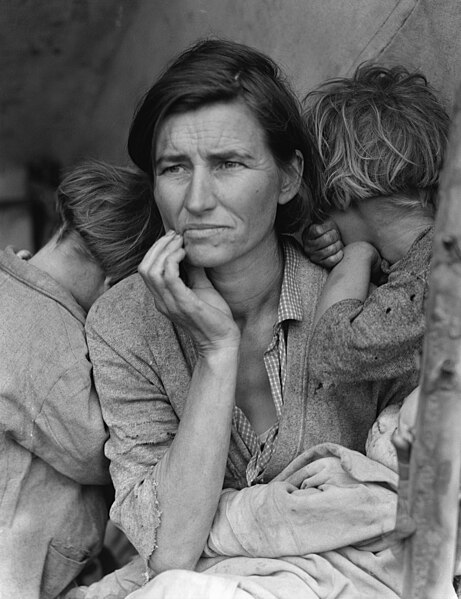
Child of "Migrant Mother" speaks


Girl from iconic Great Depression photo: 'We were ashamed'

Excerpt:

The photograph became an icon of the Great Depression: a migrant mother with her children burying their faces in her shoulder. Katherine McIntosh was 4 years old when the photo was snapped. She said it brought shame -- and determination -- to her family.

"I wanted to make sure I never lived like that again," says McIntosh, who turns 77 on Saturday. "We all worked hard and we all had good jobs and we all stayed with it. When we got a home, we stayed with it."

McIntosh is the girl to the left of her mother when you look at the photograph. The picture is best known as "Migrant Mother," a black-and-white photo taken in February or March 1936 by Dorothea Lange of Florence Owens Thompson, then 32, and her children.

Lange was traveling through Nipomo, California, taking photographs of migrant farm workers for the Resettlement Administration. At the time, Thompson had seven children who worked with her in the fields.


Comment: View CNN article (Link) for picture of Katherine McIntosh, now 77 - then 4, holding famous photo. Wiki article on Florence Owens Thompson. The Library of Congress entitles the Migrant Mother image, Destitute pea pickers in California. Mother of seven children. Age thirty-two. Nipomo, California. Six other fascinating Dorthy Lange photos of the "Migrant Mother" are available here

GM's plan

Detroit Free Press artcle: GM: Shrink brands, pay, jobs, dealers

PDF of GM Plan: Restructuring Plan for Long-Term Viability (37 pages)

Excerpts:

Hummer has recently been put under strategic review, which includes the possible sale of the brand. GM will also immediately undertake and expedite a strategic review of the Saab brand globally. Finally, Saturn, which has performed below expectations, has a unique franchise agreement and operating structure. As part of the Plan, the company will accelerate discussions with Saturn retailers and explore alternatives for the Saturn brand.

...

GM will launch the ground-breaking Chevrolet Volt in 2010. As indicated in Table 8, GM is investing over $750 million in the Volt and its propulsion system, prototypes of which are currently on test at GM‘s Milford Proving Grounds. An extended-range electric vehicle, the Volt will deliver up to 40 miles on a single electric charge, well within the daily commute of approximately 80% of Americans. Volt represents a fundamental reinvention of the American automobile industry, creating new growth and environmentally-friendly/sustainable industries, and represents a giant step toward energy independence. No other car company has made such a commitment to the American people. It involves the development of advanced batteries, power electronics, systems integration and manufacturing methods. The company‘s product plan includes additional vehicles utilizing Volt‘s extended-range electric vehicle system and potentially, the assembly of battery packs in the United States.

...

As indicated, the number of GM retailers is expected to decline to 4,700 by 2012. This will occur primarily in metropolitan and suburban areas where GM has too many dealers to serve the market. In the Plan, it is projected these dealers will be reduced by 35%, increasing annual throughput for the remaining outlets to a more competitive level with other high-volume manufacturers. GM‘s distribution strength in rural areas, which is a significant competitive advantage, will be largely preserved.


Comment: I understand they are in danger of running out of cash this month! Without aid, it could run out of cash this month: "General Motors Corp. said Tuesday it could run short of the cash it needs to operate by the end of this month if Congress doesn't approve $4 billion in emergency federal loans ... 'The first $4 billion is crucial,' GM President and Chief Operating Officer Fritz Henderson said. 'Absent support, we can't continue to operate.'"

CAFE killed the Big Three

Can the Big Three survive a bailout?

Excerpts:

... [In 1975] the institution of the Corporate Average Fuel Economy requirements designed to limit our reliance on foreign oil in the wake of the Arab oil embargo.

Instead of simply limiting foreign imports or adding federal taxes to fuel costs to give consumers an incentive to buy more fuel-efficient vehicles, the government instituted byzantine regulations that required American manufacturers to build (or at least market) fuel-efficient cars just so they could continue selling the cars and trucks they were already known for.

Since the United States had always been a country of "cheap gas," (a tradition that continues, by the way) American car companies were not geared up to build small, fuel-efficient cars, but foreign manufacturers were. The result was that Americans were almost forcibly exposed to import vehicles, and many American consumers liked what they found.

The CAFÉ regulations accompanied by inexpensive gasoline were analogous to plopping consumers into the middle of a giant candy store and then forcing the candy manufacturers to somehow persuade a percentage of consumers to buy broccoli instead.

When all was said and done, the CAFÉ rules ended up giving a strong leg up to the Big Three's import competitors, putting their market share on an upward curve that hasn't ceased climbing.

Of course, having helped push American consumers into import cars, albeit inadvertently, the federal government then tried to reverse the trend through new intervention.

At the urging of the U.S. government, the Japanese manufacturers adopted "voluntary" restraints on their exports of vehicles to the U.S. beginning in 1981. The goal was to give U.S. companies "breathing room" so they could catch up to the Japanese in producing small, fuel-efficient vehicles. (Sound familiar?)

Again, this might have seemed a worthy plan at the time, but it had several unintended consequences that ended up doing much more harm to the domestic manufacturers than good. In the short term it limited supply of popular Japanese-built vehicles, which resulted in windfall profits for the dealers of the top imports, helping those brands establish very strong dealer networks.

It influenced the import manufacturers to move up-market both by building more expensive vehicles and by establishing luxury brands like Acura, Lexus and Infiniti. And it gave strong impetus for the import manufacturers to build plants here in the United States.

Today a large percentage of the "import brand" share of the U.S. market -- more than 50 percent of the total light-vehicles sold here -- are vehicles built by Americans in foreign-managed factories on U.S. soil. Ironically, to counteract this, the Big Three automakers have increasingly moved production from the U.S. to lower-labor-cost countries like Mexico.

So what are the implications of this history lesson? The first takeaway is that a portion of the woes the domestic Big Three are suffering today are the result of current and past federal government policies, so it seems fair that they be accorded government assistance now in time of dire need.

But equally important, while the Big Three automakers might well be accused of not correctly gauging the needs and desires of the American buying public, one group that is demonstrably much worse in that endeavor is Congress. If the U.S. government were a car company, it would not only be deep in the red, but also have miserable customer satisfaction scores.


Comment: See SUVs and minivans created due to original mandate

CAFE standards signaled the end of the traditional long station wagon, but Chrysler's Lee Iacocca developed the idea of the minivan, which would fit into the separate truck category and allow automakers to comply with emissions standards. Eventually, this same idea led to the development of the SUV

Governmentium: New element on the periodic table

Heaviest Element Known to Science: Governmentium

Lawrence Livermore Laboratories has discovered the heaviest element yet known to science.
The new element,Governmentium (Gv), has one neutron, 25 assistant neutrons, 88 deputy neutrons, and 198 assistant deputy neutrons, giving it an atomic mass of 312.

These 312 particles are held together by forces called morons, which are surrounded by vast quantities of lepton-like particles called peons.

Since Governmentium has no electrons, it is inert; however, it can be detected, because it impedes every reaction with which it comes into contact. A tiny amount of Governmentium can cause a reaction that would normally take less than a second, to take from 4 days to 4 years to complete.

Governmentium has a normal half-lif e of 2- 6 years. It does not decay, but instead undergoes a reorganization in which a portion of the assistant neutrons and deputy neutrons exchange places.

In fact, Governmentium's mass will actually increase over time, since each reorganization will cause more morons to become neutrons, forming isodopes.

This characteristic of morons promotion leads some scientists to believe that Governmentium is formed whenever morons reach a critical concentration. This hypothetical quantity is referred to as critical morass.

When catalyzed with money, Governmentium becomes Administratium, an element that radiates just as much energy as Governmentium since it has half as many peons but twice as many morons.


Comment: Sent to me by a coworker (Nancy A). Here's the real periodic table

College: Tuition up 439% over 25 years.

College May Become Unaffordable for Most in U.S.

Excerpt:

... college tuition and fees increased 439 percent from 1982 to 2007, adjusted for inflation, while median family income rose 147 percent. Student borrowing has more than doubled in the last decade, and students from lower-income families, on average, get smaller grants from the colleges they attend than students from more affluent families.


Comment: 2 of my children are still in college. One is closing in on his Associates' degree (paying his own way while working), the other is working on a Bachelor's (Engineering). He is funding his by work, VA benefits, and tuition reimbursement. Both (along with my daughter) eschewed student loans.

Bailouts mean the government will "tax you more for a very long time"

Even in Michigan, Not Everyone Wants a Lifeline

Excerpt:

Jeffrey Kerr, a real estate developer who lives in the Lake Michigan town of Saugatuck, objects to the personal costs that he says come with bailouts. “When the government starts bailing out private companies,” Mr. Kerr said, “what they’re basically saying is, ‘We’re going to tax you more for a very long time.’ ”

Pat Weber, a construction manager who was laid off last year in Fennville, near Saugatuck, largely agreed. “A bailout will cause a snowballing effect,” Ms. Weber said, “and it’s way too scary how it will come back on all of us.”

At the shop where Mr. Raterink makes tools and machinery, there used to be 15 men. Now there are five.

“They weren’t offered any bailout,” he said of those who lost their jobs. Then, of the Big Three and the mismanagement he perceives, he added, “The wolf you let loose is at your door.”


Comment: Interesting read about how the average Michigan "Joe" is disinclined to auto bailouts. See George Will column below for his view that government intervention actually exasperates recessions.

Same Old New Deal?

Excerpts:

In a 2004 paper, Harold L. Cole of the University of California at Los Angeles and Lee E. Ohanian of UCLA and the Federal Reserve Bank of Minneapolis argued that the Depression would have ended in 1936, rather than in 1943, were it not for policies that magnified the power of labor and encouraged the cartelization of industries. These policies expressed the New Deal premise that the Depression was caused by excessive competition that first reduced prices and wages and then reduced employment and consumer demand. In a forthcoming paper, Ohanian argues that "much of the depth of the Depression" is explained by Hoover's policy — a precursor of the New Deal mentality — of pressuring businesses to keep nominal wages fixed.


Furthermore, Hoover's 1932 increase in the top income tax rate, from 25 percent to 63 percent, was unhelpful. And FDR's hyperkinetic New Deal created uncertainties that paralyzed private-sector decision making. Which sounds familiar.

...

Barack Obama says that the next stimulus should deliver a "jolt." His adviser Austan Goolsbee says that it must be big enough to "startle the thing into submission." Their theory is that the crisis is largely psychological, requiring shock treatment. But shocks from government have been plentiful.


Unfortunately, one thing government can do quickly and efficiently — distribute checks — could fail to stimulate because Americans might do with the money what they have been rightly criticized for not doing nearly enough: Save it. Because individual consumption is 70 percent of economic activity, St. Augustine's prayer ("Give me chastity and continence, but not yet") is echoed today: Make Americans thrifty but not now.


Obama's "rescue plan for the middle class" includes a tax credit for businesses "for each new employee they hire" in America over the next two years. The assumption is that businesses will create jobs that would not have been created without the subsidy. If so, the subsidy will suffuse the economy with inefficiencies — labor costs not justified by value added.

12.02.2008

Thanksgiving Leftovers

What’s Left Over From Thanksgiving Now That All The Good Leftovers Have Been Eaten?


  • Whipped Cabbage Salad
  • Gravy Skin Rollups
  • Mashed Potatoes with Turkey Drippings and Gummi Worms
  • Blue High-Bounce Squash Balls
  • Pumpkin Pie With Wishbone Marrow
  • Uncle Ken’s Five-Alarm Tex-Mex Brussels Sprouts
  • Quad-Baked Potatoes
  • Cornish Game Skunk
  • Candied Gizzards
  • The Last 200 Bucks’ Worth Of The $12,000 Cheese-Spread Sculpture Of Squanto We Commissioned For Our Office Thanksgiving Party
  • Cranberry Sauce


Comment: I hate that leftover Cranberry Sauce. (For my daughter who brought Cranberry Sauce for dinner!)

New .Tel domain - a phone book for the Internet

.Tel Them Where to Find You

Excerpt:

On Wednesday, companies and organizations can register Web addresses with a new top-level domain, .tel. The new domain, which stores and encrypts contact information directly into the Domain Name System, has the potential to become a phone book for the Internet.

A .tel domain name links to the contact information of businesses, organizations and individuals. Information can include telephone numbers; links to Web sites, including a Facebook or MySpace page; e-mail addresses; instant messaging names,


Comment: Official site ... check out the simulator! General availability is March 24th, 2009. Perhaps a little pricey at $ 19.95 per year (for individuals).

The "new General Motors"

Pursuing U.S. Aid, G.M. Accepts Need for Drastic Cuts

Excerpt:

G.M. said its plan would create a “new General Motors,” that will be significantly smaller and more competitive.

The company said it would sell off its Hummer and Saab brands, shrink its Pontiac brand into a niche vehicle division, and explore opportunities to sell, close or consolidate the Saturn brand that — when it was started in the 1980s — was supposed to be G.M.’s answer to the smaller, fuel-efficient cars sold by Japanese competitors.


Comment: Out with Saturn, Saab, Hummer, and Pontiac.

Ford's Business plan submission

FORD MOTOR COMPANY SUBMITS BUSINESS PLAN TO CONGRESS; PROFIT TARGET, ELECTRIC CAR STRATEGY AMONG NEW DETAILS

Excerpt:

Ford Motor Company this morning submitted to Congress its comprehensive business plan, which details the company’s plan to return to profitability and outlines a request for potential access to a temporary bridge loan in case the current economic crisis worsens or there is a bankruptcy of a major competitor.

In the plan, Ford said the transformation of its North American automotive business will continue to accelerate through aggressive restructuring actions and the introduction of more high-quality, safe and fuel-efficient vehicles – including a broader range of hybrid-electric vehicles and the introduction of advanced plug-in hybrids and full electric vehicles.

Ford is asking for access to up to $9 billion in bridge financing, but reiterated that it hopes to complete its transformation without accessing the loan should Congress agree to make the funds available.

Despite the serious global economic downturn, Ford said it does not anticipate a liquidity crisis in 2009 – barring a bankruptcy by one of its domestic competitors or a more severe economic downturn that would further cripple automotive sales and create additional cash challenges.


Comment: Link below is full PDF (33 pages). Interesting comments on the economy.

FORD MOTOR COMPANY BUSINESS PLAN - SUBMITTED TO THE SENATE BANKING COMMITTEE

Excerpts:

The forward economic outlook is also negative, with a wide range of possible outcomes due to the uncertain financial market environment. Real GDP is projected to decline significantly in the current quarter, as much as 4% or more as compared to the prior quarter (at an annualized rate). Consumer confidence is the weakest since the early 1980s, with nearly three in four consumers expecting the recession to deepen in the months ahead, according to the recent Survey of Consumers report released by Reuters/University of Michigan.

The economy is projected to contract through the first half of 2009, with a peakto-trough decline in real GDP in the 2.0% to 2.5% range. The housing sector decline, as measured by housing starts and sales, is expected to weaken somewhat from already low levels.

Spending by consumers has already fallen at an annual rate of nearly 4% in the third quarter (as compared to the second quarter). A further contraction in consumer spending is underway in the current quarter, with an additional step down likely in the first quarter of 2009. Consumers are weighing likely further employment declines and responding by increasing their saving rates and pulling back on purchases, especially of durable goods such as automobiles.

The financial crisis, now 16 months old, persists. Despite the actions taken by the Federal Government and the Federal Reserve (and other governmental institutions around the world), there is no near-term end in sight.


... we are acutely aware that our supply base, our labor structure, and our dealer network, among other factors, are sized for an industry and a market share that the domestic companies can no longer support.


there are other important policies that will help enhance the industry’s global competitiveness. First, Ford was proud to support stronger CAFE standards, and we are absolutely committed to meeting them. However, we urge Congress to maintain one economy-wide set of national standards on fuel economy. A patchwork of standards would place enormous financial and engineering burdens on manufacturers and have the effect of reducing consumer choice -- all for little or no environmental benefit.


Throughout the 1990s and into this decade, we became increasingly dependent in the U.S. market on trucks and large SUVs, which were in heavy demand by consumers and generated large profits. Many of our competitors, both foreign and domestic, likewise followed market demand and added more truck and SUV products to their lineups. Our focus on these vehicles, however, left us exposed in the event of a market shift to smaller, more fuelefficient vehicles. In anticipation of such a shift, and inspired by the compelling vision outlined by our Executive Chairman, Bill Ford, we began to refocus our portfolio earlier in this decade, introducing a new line of mid-size cars (the Fusion, Milan, and MKZ) as well as the first hybrid sport utility (the Ford Escape -- still the most fuel efficient sport utility available with an EPA city mileage rating of 34 miles per gallon). When fuel prices shot up rapidly earlier this year, the shift occurred much more quickly and was much more pronounced than we or anyone else in the industry anticipated.

In addition, we had, over a period of many years, created a labor structure that was uncompetitive with the foreign-owned transplant operations that had been established in the United States. And, we made small cars in the United States largely because of a requirement to meet federal Corporate Average Fuel Economy standards.


Comment: A worthwhile read.

How long the Recession?

The Longest Recession Since …

Excerpt:

Economists have been forecasting that the current recession will likely end sometime in the spring (which is, presumably, when some of the new stimulus money will start to be spent). If they’re right, this recession will be roughly as long as the 1973-75 recession and the 1980-81 recession, both of which were 16 months. To find a longer one than that, you have to go back to the Depression.


Comment: I'm pessimistic about that time frame because:


  1. I have read about a commercial real estate mortgage crisis (Meltdown far from over, new mortgage crisis looms)
  2. I don't think housing is anywhere close to bottoming out (Housing Prices: Bottom or Temporary Bear Break?) (By the way: Good news if you are buying a home!)
  3. There are more ARM resets that will force more into foreclosure (Closer Look At The ARMs Reset Problem)
  4. The last stimulus package seemed to do so little (Reality Checks: Living costs are keeping stimulus-money recipients from going on shopping sprees)
  5. The national savings rate is so low, and consumers are so extended that they are unable to borrow (see yesterday's posting)
  6. Back to the stimulus: putting money into consumers' wallets to have them spend on imported goods (think of China-Mart (er Wall Mart)) really does nothing to help US manufacturing
  7. Job losses are just beginning to climb (coincidentally, a guy at work told me just today that today is his last day!)


My own thought is that the recession may go all the way through 2009 and end in the 1st or 2nd QTR of 2010.

12.01.2008

Potential borrowers are not credit worthy

Bailout Monitor Sees Lack of a Coherent Plan

Excerpts:

“You can’t just say, ‘Credit isn’t moving through the system,’ ” she said in her first public comments since being named to the panel. “You have to ask why.”

If the answer is that banks do not have money to lend, it would make sense to push capital into their hands, as the Treasury has been doing over the last two months, she continued. But if the answer is that their potential borrowers are getting less creditworthy with each passing day, “pouring money into banks isn’t going to fix that problem,” she said.

...

In her view, the government should be trying to create more reliable customers for those banks by shoring up the fragile finances of the millions of American families that could not save, borrow or spend even if their banks were flush with capital.

“Any effective policy has to start with the households,” she said. “Years of flat wages, low savings and high debt have left America’s households extremely vulnerable.”


Comment: Heard: GMAC will not make a car loan to anyone with less than a 700 FICO score. GMAC limits loans to buyers with 700+ FICO rating. We need a long term national program to encourage savings and investing. See: In 2005, the U.S. savings rate hit negative levels for the first time since the Great Depression. (article has graph)

Bernanke: won't be like Great Depression

Bernanke says crisis 'no comparison' to Great Depression

Excerpt:

Federal Reserve chairman Ben Bernanke said Monday the current economic situation bears "no comparison" to the much deeper crisis of the 1930s Great Depression.

"Well, you hear a lot of loose talk, but let me just ... say, as a scholar of the Great Depression -- and I've written books about the Depression and been very interested in this since I was in graduate school, there's no comparison," Bernanke said in a question period after an address in Austin, Texas.

Bernanke cited "an order-of-magnitude difference" in the current situation compared to the 1930s.

"During the 1930s, there was a worldwide depression that lasted for about 12 years and was only ended by a world war," he said.

"During that time, the unemployment rate went to 25 percent, at least, based on the data that we have. The real GDP (gross domestic product) fell by one-third. About a third of all of the banks failed. The stock market fell 90 percent."

Bernanke said the situation at that time represented "very difficult circumstances," because "we didn't have the social safety net that we have today. So let's put that out of our minds; there's no -- there's comparison in terms of severity."

He added, "We're very lucky to live in a country as rich and diversified as the one we have. And I hope that we will have a quick and rapid recovery from the current slowdown."

Still, the Fed chief said lessons learned from the Depression may still apply today, including the "excessively tight monetary policy" that led to higher interest rates and deflation of about 10 percent a year over the first three years of the 1930s.

"We have learned from that experience that monetary policy has got to be proactive and supportive of the economy in a situation of difficult financial conditions," he said.

"The other part was -- the other error, the big mistake that policymakers made in the early '30s was they essentially allowed the financial system to collapse and they didn't do anything about it. The Federal Reserve did no action as the banks failed by the hundreds and the thousands."


Comment: It'll be the worst recession in our lifetimes (unless you are the age of my 88 year old Mother)

The Death of Credit Cards?

The Death of Credit Cards

Excerpt:

Meredith Whitney -- bank analyst extraordinaire -- predicts that the credit card industry may slash more than $2 trillion of existing credit lines -- 45% of the total -- over the next year and a half. Yikes! The obvious outcome here would be a huge risk reduction for companies that issue consumer credit, such as JPMorgan Chase (NYSE: JPM), Bank of America (NYSE: BAC), and Citigroup (NYSE: C), while kicking an already-bloodied consumer -- and to a lesser extent, card processors Visa (NYSE: V) and MasterCard (NYSE: MA) -- while they're down.

The big question is whether those consumers deserve to be kicked, with all due respect. Among the more disturbing tidbits Whitney mentions in her report is that credit cards serve as consumers' second most important source of "consumer liquidity," behind actual jobs. Why is it disturbing? In any healthy economy, you'd expect savings to be the closest backstop to job income, not credit cards.

One of the key reasons we're in such a bind right now is that consumers scoffed at saving for a rainy day, and instead spent like there'd be eternal sunshine. Sure, a 45% contraction in credit-card lines will be miserable for some, but the harsh reality going forward is that people will be restricted to purchasing things they can actually afford. I know -- it's a tough concept to grasp.

All of this highlights what I think is one of the biggest fallacies we're facing today: the notion that the key to an economic recovery is getting consumers back to previous spending levels, without realizing that those same levels of spending are partially what ushered in this mess. There's no way around it -- the key to a stabilized economy is to get people to spend less and save more. Unfortunately, that'll mean a reduction in the standard of living for those reliant on plastic to begin with, not to mention the economy as a whole, which is composed of roughly 70% consumer spending.

That said, R.I.P., credit cards. You won't be missed.


Comment: I don't see CC's going away. The point highlighted above is key!

It's official: Recession Declared

Dow Plunges 680 Points as Recession Is Declared

Excerpt:

This is the first official recession since 2001, when the economy suffered after the bursting of the technology bubble. The period of expansion lasted 73 months, from November 2001 to December 2007.


Determination of the December 2007 Peak in Economic Activity

Excerpt:

The committee maintains a chronology of the beginning and ending dates (months and quarters) of U.S. recessions. The committee determined that a peak in economic activity occurred in the U.S. economy in December 2007. The peak marks the end of the expansion that began in November 2001 and the beginning of a recession. The expansion lasted 73 months; the previous expansion of the 1990s lasted 120 months.

A recession is a significant decline in economic activity spread across the economy, lasting more than a few months, normally visible in production, employment, real income, and other indicators. A recession begins when the economy reaches a peak of activity and ends when the economy reaches its trough. Between trough and peak, the economy is in an expansion.

Because a recession is a broad contraction of the economy, not confined to one sector, the committee emphasizes economy-wide measures of economic activity. The committee believes that domestic production and employment are the primary conceptual measures of economic activity.

The committee views the payroll employment measure, which is based on a large survey of employers, as the most reliable comprehensive estimate of employment. This series reached a peak in December 2007 and has declined every month since then.


NBER list: Business Cycle Expansions and Contractions


PeakTroughContractionExpansionCycle (peak to peak)
November 1948October 1949113745
July 1953May 1954104556
August 1957April 195883949
April 1960February 1961102432
December 1969November 197011106116
November 1973March 1975163647
January 1980July 198065874
July 1981November 1982161218
July 1990March 1991892108
March 2001November 20018120128
December 2007??????7381


Comment: I remember the recession of 1975. I was a computer salesman (IBM) and sales (and commissions) dropped off significantly.

Here's my question: If December 2007 was the last peak, when do you expect the trough?

How a 50 year-ish deputy sheriff infiltrated Anarchist organization

'Anarchist' looked like someone's mom

Comment: From the Star Tribune. Worthwhile read. Star Tribune links disappear after a while so read it while it is available.

Excerpts:

On Aug. 31, 2007, Marilyn Hedstrom, who appeared to be in her early 50s, walked into a run-down store-front where anarchists hung out on E. Lake Street in Minneapolis.

She introduced herself as Norma Jean.

Asked by a man at the Jack Pine Center why she was there, she said she had issues with President Bush and the Iraq war. "I told him I was interested in helping the cause and interested in participating in the protesting,"

...

What she did not tell him is that she was a deputy sheriff for the Ramsey County Sheriff's Office. Along with two other undercover sheriff's operatives and an FBI informer, she had been assigned to infiltrate the RNC Welcoming Committee, which was planning street blockades at the 2008 Republican National Convention.

She went "dumpster diving" at the group's instructions to find food for the anarchists to eat. She cooked meals for some meetings, ran errands, coordinated committee discussions and represented the organization at some gatherings of the protest movement. She became friends of some of the activists. And she, ironically, even helped on security for the anarchists, who worried that the cops were infiltrating them.

For a year Deputy Hedstrom led a double life as Norma Jean Johnson, filing her recollections, often daily, with the Special Investigations Unit, as did the other operatives.

...

"Norma Jean looked like somebody's mom," recalls Meredith Aby, a member of the Anti-War Committee, a group that occasionally met with the anarchists. "She was treated by the Welcoming Committee as if she were one of their own."

Betsy Raasch-Gilman, 56, who helped raise money with Hedstrom on the Welcoming Committee, said they sometimes discussed family and grandchildren. "To this day, I don't know how much was put-on and how much was real," she said. Raasch-Gilman learned that Hedstrom was undercover after court documents were filed

From the Big Three ... a Big One?

And Then There Was One - Distilling the Big Three into a single player could save Detroit.

Excerpts:

The notion of three powerful U.S. automakers is already an anachronism. These companies are husks of the mighty institutions that once ruled the road. Now they control less than half the U.S. auto market and will lose a combined $30 billion this year. Collectively they are burning through nearly $6 billion a month, and General Motors and Chrysler warn that by the end of the year they'll be broke. They'll head back to Washington this week (ideally by car pool) to beg for a bailout.

But Detroit actually has parts worth saving. Melding them into a single entity could buff up its best brands, like Chevy, Ford and Cadillac, while leaving the clunkers (Pontiac, Mercury, Saturn, et al.) by the side of the road. It would take a healthy dose of Nietzsche's "creative destruction," but that's preferable to total destruction, especially when you're talking about an industry that supports 2.5 million jobs. Other major American industries have undertaken calamitous consolidations to survive. Why should Detroit be spared from market forces?

...

After the Berlin Wall came down in 1989 and the end of the Cold War led to shrinking defense contracts, America's aviation companies began falling into one another's arms. Boeing grabbed up all U.S. civil-aircraft business, acquiring its chief domestic rival McDonnell Douglas in 1997. That allowed Boeing to take on the true competition: Europe's Airbus.

...

Like autos, foreign competition laid waste to the American steel industry. Beginning in 1986, more than 35 American steel makers went bankrupt. In 2002, billionaire investor Wilbur Ross agreed to buy up bankrupt LTV Steel, setting off a merger frenzy that saw 17 companies shrink down to three, while financial results reversed from a $1.1 billion loss in 2003 to a $6.6 billion profit in 2004. Ross used the bankruptcy courts to renegotiate labor contracts and hire back a fraction of the workers.

... some say Detroit's salvation could come in the form of a prepackaged bankruptcy, a quicker reorganization where creditors agree to cuts up front that would hopefully be less disruptive to the overall economy. With government backing to secure loans and preserve car warranties, buyers might not turn away.

Bankruptcy could solve another intractable problem: Detroit's glut of dealers and car brands. The Big Three need to cut their dealers by one third but are blocked by state franchise laws. In bankruptcy, carmakers can tear up franchise contracts and wipe out entire brands. The question is, would a Wilbur Ross-type speculator come along to consolidate the remains of the domestic auto industry?


Comment: I think "the Big Three" is essentially a misnomer. Chrysler is virtually a non-player. Maybe "the Big Two and a Half" or "The General, a Sergeant, and a buck private". My own solution is a "Government-Sponsored-Bankruptcy". Brands worth saving: GM: Cadillac, Chevrolet, Buick; Ford: Ford and Lincoln; Chrysler: Jeep and their mini-vans. Perhaps Ford should buy Chrysler and retain the Jeep brand. All will be interesting to see it unfold.

1836 all over again


The Madness of Crowds

Excerpt:

Let us begin our account of the catastrophic effects of speculative bubbles and political gamesmanship with the collapse of 1836. Thanks to a growing population, prosperity, and the advancing frontier, poorly regulated state banks had been multiplying throughout the 1830’s. In those days, chartered banks issued paper money, called banknotes, backed by their reserves. From 1828 to 1836, the amount in circulation had tripled, from $48 million to $149 million. Bank loans, meanwhile, had almost quadrupled to $525 million. Many of the loans went to finance speculation in real estate.

Much of this easy-credit-induced speculation had been caused, as it happens, by President Andrew Jackson. This was a terrific irony, since Jackson, who served as President from 1829 until 1837, hated speculation, paper money, and banks. His crusade to destroy the Second Bank of the United States, an obsession that led him to withdraw all federal funds from its coffers in 1833, removed the primary source of bank discipline in the United States. Jackson had transferred those federal funds to state banks, thereby enabling their outstanding loans to swell.

The real-estate component of the crisis began to take shape in 1832, when sales by the government of land on the frontier were running about $2.5 million a year. Some of the buyers were prospective settlers, but most were speculators hoping to turn a profit by borrowing most of the money needed and waiting for swiftly-rising values to put them in the black. By 1836, annual land sales totaled $25 million; in the summer of that year, they were running at the astonishing rate of $5 million a month.

While Jackson, who was not economically sophisticated, did not grasp how his own actions had fueled the speculation, he understood perfectly well what was happening. With characteristic if ill-advised decisiveness, he moved to stop it. Since members both of Congress and of his cabinet were personally involved in the speculation, he faced fierce opposition. But in July, as soon as Congress adjourned for the year, Jackson issued an executive order known as the “specie circular.” This forbade the Land Office to accept anything but gold and silver (i.e., specie) in payment for land. Jackson hoped that the move would dampen the speculation, and it did. Unfortunately, it did far more: people began to exchange their banknotes for gold and silver. As the demand for specie soared, the banks called in loans in order to stay liquid.

The result was a credit crunch. Interest rates that had been at 7 percent a year rose to 2 and even 3 percent a month. Weaker, overextended banks began to fail. Bankruptcies spread. Even several state governments found they could not roll over their debts, forcing them into default. By April 1837, a month after Jackson left the presidency, the great New York diarist Philip Hone noted that “the immense fortunes which we heard so much about in the days of speculation have melted like the snows before an April sun.”

The longest depression in American history had set in. Recovery would not begin until 1843. In Charles Dickens’s A Christmas Carol, published that same year, Ebenezer Scrooge worries that a note payable to him in three days might be as worthless as “a mere United States security.”


Comment: See also Panic of 1837. Image is from the Wiki article. Sent to me by my son, Roger. It's almost as if there is a 40 year stupidity cycle. See Panic of 1873