Showing posts with label Great Depression. Show all posts

4.26.2009

Market rebound in 4½?

25 Years to Bounce Back? Try 4½

Excerpt:

HISTORICAL stock charts seem to show that it took more than 25 years for the market to recover from the 1929 crash — a dismal statistic that has been brought to investors’ attention many times in the current downturn.

But a careful analysis of the record shows that the picture is more complex and, ultimately, far less daunting: An investor who invested a lump sum in the average stock at the market’s 1929 high would have been back to a break-even by late 1936 — less than four and a half years after the mid-1932 market low.


Comment: That would be great ... 4½!

4.17.2009

Great Depression parallels

IMF warns over parallels to Great Depression

Excerpts:

This recession is likely to be "unusually long and severe, and the recovery sluggish," said the Fund, releasing two advance chapters from its World Economic Outlook. However, it warned there is a risk that it could spiral down into a full-blown slump unless further action is taken to stop "feedback effects" gathering force.

Dominique Strauss-Kahn, head of the IMF, said millions of people risk being pushed back into poverty as the economic storm ravages the most vulnerable countries. "The human consequences could be absolutely devastating. This is a truly global crisis, and nobody is escaping," he said.

...

The IMF said the US is at the epicentre of this crisis just as it was in the Depression, setting the two episodes apart from normal downturns. However, the risks are greater this time. "While the credit boom in the 1920s was largely spec­ific to the US, the boom during 2004-2007 was global, with increased leverage and risk-taking in advanced economies and many emerging economies. Levels of integration are now much higher than during the inter-war period, so US financial shocks have a larger impact," it said.

The IMF said the global financial system is still under acute stress, with output tumbling and inflation falling towards zero in key nations. "The risks of debt deflation have increased," it said.

Abrupt halts in capital flows can have "dire consequences" for emerging economies, it said. Eastern Europe has already suffered the effects, with a 17.6pc fall in industrial production in February. The region is highly vulnerable to the credit crunch since it owes more than 50pc of its GDP to Western banks.


Comment: Exaggeration?

12.03.2008

Child of "Migrant Mother" speaks


Girl from iconic Great Depression photo: 'We were ashamed'

Excerpt:

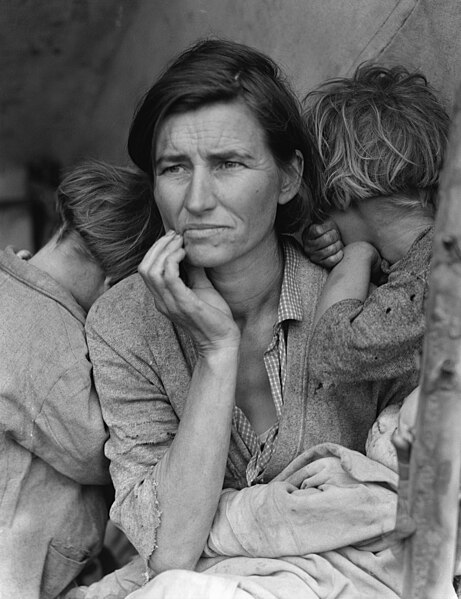
The photograph became an icon of the Great Depression: a migrant mother with her children burying their faces in her shoulder. Katherine McIntosh was 4 years old when the photo was snapped. She said it brought shame -- and determination -- to her family.

"I wanted to make sure I never lived like that again," says McIntosh, who turns 77 on Saturday. "We all worked hard and we all had good jobs and we all stayed with it. When we got a home, we stayed with it."

McIntosh is the girl to the left of her mother when you look at the photograph. The picture is best known as "Migrant Mother," a black-and-white photo taken in February or March 1936 by Dorothea Lange of Florence Owens Thompson, then 32, and her children.

Lange was traveling through Nipomo, California, taking photographs of migrant farm workers for the Resettlement Administration. At the time, Thompson had seven children who worked with her in the fields.


Comment: View CNN article (Link) for picture of Katherine McIntosh, now 77 - then 4, holding famous photo. Wiki article on Florence Owens Thompson. The Library of Congress entitles the Migrant Mother image, Destitute pea pickers in California. Mother of seven children. Age thirty-two. Nipomo, California. Six other fascinating Dorthy Lange photos of the "Migrant Mother" are available here

12.01.2008

Bernanke: won't be like Great Depression

Bernanke says crisis 'no comparison' to Great Depression

Excerpt:

Federal Reserve chairman Ben Bernanke said Monday the current economic situation bears "no comparison" to the much deeper crisis of the 1930s Great Depression.

"Well, you hear a lot of loose talk, but let me just ... say, as a scholar of the Great Depression -- and I've written books about the Depression and been very interested in this since I was in graduate school, there's no comparison," Bernanke said in a question period after an address in Austin, Texas.

Bernanke cited "an order-of-magnitude difference" in the current situation compared to the 1930s.

"During the 1930s, there was a worldwide depression that lasted for about 12 years and was only ended by a world war," he said.

"During that time, the unemployment rate went to 25 percent, at least, based on the data that we have. The real GDP (gross domestic product) fell by one-third. About a third of all of the banks failed. The stock market fell 90 percent."

Bernanke said the situation at that time represented "very difficult circumstances," because "we didn't have the social safety net that we have today. So let's put that out of our minds; there's no -- there's comparison in terms of severity."

He added, "We're very lucky to live in a country as rich and diversified as the one we have. And I hope that we will have a quick and rapid recovery from the current slowdown."

Still, the Fed chief said lessons learned from the Depression may still apply today, including the "excessively tight monetary policy" that led to higher interest rates and deflation of about 10 percent a year over the first three years of the 1930s.

"We have learned from that experience that monetary policy has got to be proactive and supportive of the economy in a situation of difficult financial conditions," he said.

"The other part was -- the other error, the big mistake that policymakers made in the early '30s was they essentially allowed the financial system to collapse and they didn't do anything about it. The Federal Reserve did no action as the banks failed by the hundreds and the thousands."


Comment: It'll be the worst recession in our lifetimes (unless you are the age of my 88 year old Mother)