Showing posts with label Sears. Show all posts

5.12.2017

What Sears and Fundamentalist Churches have in common


Edward Lampert: Sears' Troubles Are Everyone's Fault But Mine

Excerpt:

In a somewhat hard-to-believe interview with the Chicago Tribune, Lampert gave many reasons for the company’s continued downward spiral. His claim: he is going to “...[turn] Sears into a 21st-century merchant focused on catering to its best customers.” It remains a mystery how that will be supported after selling off iconic brands, running the company without a seasoned merchant at the helm, and spinning off parts of the business that actually added value (Lands End).

Yet Lampert seems to think he’s made great progress. In his own words, “We’re ahead of J.C. Penney, we’re ahead Macy’s, we’re ahead of Target in some aspects of where the world is going.” That would be true if where they’re all going is closing stores and selling off assets, but otherwise, it’s really hard to accept. Where’s the great product? Where’s the customer experience? Fellow analyst Cathy Hotka has repeatedly called the Sears Holdings situation “the world’s longest liquidation sale.” It’s very hard to disagree. 

It’s incomprehensible that one of the world’s largest retailers (No. 18 on Stores Magazine 2015 Top 100 Retailers list) is being run by someone with no retail experience whatsoever.

Retail is an industry that plays an enormous part in the U.S. economy. Having been involved in it for my whole life, I can tell you that “Retail’s different.” If you focus solely on selling to your best customers, you might never get any new ones. The best retailers find ways to increase the transaction size (called “market basket” in the trade) and shopping frequency of their average customers. Looked at slightly differently, as a former boss of mine once said, it’s harder to turn an “A” store into an “A+” store. It’s a much better bet to move C’s to B’s and B’s to A’s. That’s a retailer’s challenge. Not catering to true believers.

Recent times have taught us that some chief executives can make an effective transition from other industries into retail. Best Buy’s Hubert Joly comes to mind, as does Home Depot’s now retired Frank Blake. But they have to become students of the customer experience. And they must find ways to empower employees and excite customers. After six years of declining results, you might want to see if you can encourage shoppers to come back to your company, not milk the ones you think will never leave you.
The Decline in Fundamentalism

Excerpt:

We owe a massive debt of gratitude to the pioneers of the fundamentalist movement. Sadly, few Christians understand the necessity of the war they fought in the last century. If not for their bold stand, the vast majority of American churches probably would have capitulated to the influence of theological liberalism—a juggernaut that spiritually devastated Europe, the heartland of the Reformation.

The original fundamentalists were American theologians and pastors who understood that some biblical doctrines are too precious to take lightly. They resolutely defended foundational Christian truths like biblical inerrancy, the exclusivity of Christ, His resurrection, the realities of eternal life and eternal damnation, and human depravity. Those first fundamentalists prevailed through their unwavering commitment to God’s Word and refusal to negotiate on its truth. They are the reason why liberalism never overran the American church landscape, and why we can still find churches today where Scripture is supreme and the gospel is faithfully preached.

Sadly, however, the fundamentalist movement began to unravel almost as soon as it had experienced its initial successes. One wing of fundamentalism, desperate for academic respectability, could not resist the pluralism of the modern age. Schools that had been founded to counter theological liberalism were overexposed to liberal theology and began to compromise on the issue of biblical inerrancy, capitulating at the very point where early fundamentalism had taken its strongest stand. Incredibly, some fundamentalist schools and churches abandoned their commitment to biblical inerrancy within one generation of their founding! Most of these institutions and the people associated with them quickly repudiated the designation fundamentalist.

Another wing of fundamentalism moved the opposite direction. They were keenly aware that an obsession with academic respectability had led their brethren to abandon the fundamentals. For that reason they distrusted scholarship or spurned it altogether. This right wing of the fundamentalist movement was relentlessly fragmented by militant separatism. Legalism led to an extreme emphasis on external issues. Petty concerns often replaced serious doctrine as the matter for discussion and debate. This branch of the movement quickly reached the point where some of its adherents spent more time arguing about men’s hair length and women’s clothing than they spent defending the real fundamentals of the faith.

All the squabbling and extreme legalism eventually sullied the term fundamentalism. Intellectually and temperamentally, these fundamentalists utterly abandoned the high ground that the fathers of the movement had held so tenaciously. As a consequence the movement succumbed to a subtle depreciation of doctrine. The published material from this side of fundamentalism is notable for its total lack of any significant works with real doctrinal or biblical depth. The term fundamentalist became exclusively linked with this militant group.

In recent years, the term fundamentalist has been hijacked by the secular media, who apply it to every conceivable kind of religious fanatic.
Comments: Top image (Church) source. 2nd image (Sears) source.

First the obvious: Sears is a retail store chain and fundamentalist churches are churches. In this they are not the same. Some might conclude that what they have in common is "shoppers" and shoppers have fickle tastes. This may be true but it's not the point I wish to make.

Here's what they have in common:

  • They both were giants in America in their own rights. Sears was the place for appliances, clothing, tools and lawn equipment, auto repair and more. Fundamentalist churches were the bastion of Bible truth, evangelism and conservative worship.
  • They both are a sullied brand. Proof: ask a millennial about his view of Sears. As for fundamentalism ... see this.
  • Excursus: I used to equate the terms "Baptist" and "Fundamentalism" and perhaps at one point the terms were very closely associated. But in time the term "baptist" became diminished and churches became Fundamentalist churches associated with a fundamental lifestyle (perhaps learned at a Bible college and enforced by a student handbook and demerit system). Baptist principles such as the priesthood of the believer and individual soul liberty evaporated.
  • The big "in common" is that just like Sears is looking to "sell [solely] to [its] best customers [instead of] get[ting] any new ones", fundamental churches are looking to gain disciples like them instead of winning new converts through aggressively taking the truth of the gospel to the neighbors next door. Example: Are you the Christian who has a beer now and then? You're not the disciple we want! Fundamentalism with its associated "legalism led to an extreme emphasis on external issues"
  • Reality check for a fundamentalist church: If there are new members, what is their source: For many it's the children of existing members and some changing churches for some external issue that became debatable in their former church: musical style, et cetera.


12.08.2016

Sears: The Titanic of retail


The Titanic of retail: Sears is 'set to sink' as stores close, executives flee, and the CFO admits the brand is falling short

Excerpt:

Neil Saunders, the CEO of the retail consulting firm Conlumino, likened Sears to the Titanic on Thursday, saying it "looks set to sink." In a note to clients, he said the company's plan to restore profitability is a sham, writing, "the funds raised are not being used to develop of growth the firm — they are being used to prop up an ailing and failed business." "In our view, it is now too late to turn this around," Saunders wrote. "It is just not financially feasible to reverse it."
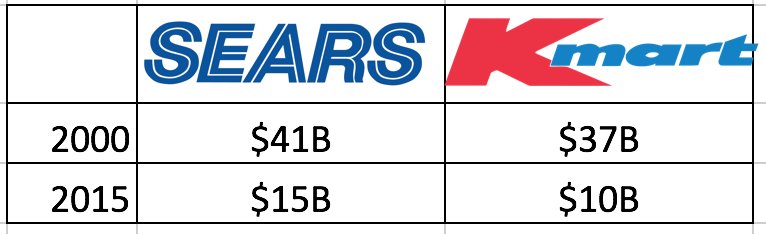
Comment: The end is near. Chart above is sales decline from 2000 to 2015.  All Sears posts

Update: Sears Transformed America. It Deserves to Die With Dignity.
Sears revolutionized American retail not once but twice, and made a lot of Americans immeasurably better off. But Sears built a great business for an America that no longer exists: eyes on the burgeoning suburbs, lives centered on cars, aesthetics relentlessly bourgeois. That business required a lot of investment in both business expertise and real estate that the company could not change, or shed, as fast as America changed around it. And there's no shame in that. Even the brightest stars eventually burn out.

Update on 1/9/17: Inside Sears' death spiral: How an iconic American brand has been driven to the edge of bankruptcy
Lampert, a former Wall Street prodigy, took control of Sears more than a decade ago and became its CEO in 2013. But he's rarely seen in the office, typically visiting about once a year for the shareholder meeting and projecting into videoconference rooms at Sears' Hoffman Estates, Illinois, headquarters the rest of the time, according to interviews with employees. He prefers to stay on Indian Creek Island, off the coast of Miami, behind a desk dressed up with the Sears logo. The island has been dubbed the "billionaire bunker," partly because of a private police force that protects the island's 86 residents.

"The only way you see Eddie is through a screen," one former executive told Business Insider. "We used to joke about who had to go upstairs to get fixed and see Oz."

Lampert's physical absence might be better received if Sears, which also owns Kmart, was in better shape. But the retailer, famous for selling everything from shoes to vacuum cleaners to whole houses, is facing its biggest crisis ever. It's closing hundreds of stores. Others are in shambles, with leaking ceilings and broken escalators. In some, employees hang bedsheets to shield shoppers from sections that stand empty. ...

The employees who spoke to Business Insider describe an internal mess with a revolving door of executives and low morale. Senior executives say Lampert has cut investments in stores because he's trying to turn it into a tech company that collects and sells customer data through the Shop Your Way program. In the past, Lampert has defended his strategy, saying he intends to turn Sears into a more "asset-light" organization, but one that would still include physical stores. He denies widespread claims that he's stripping the company of all its most valuable properties and brands and hastening its bankruptcy. At the same time, he has executed a series of real-estate and financial transactions to help prop up Sears. While the failure of the company could certainly wipe out his hedge fund's investment in the stock, these deals have set Lampert up to benefit in other ways, creating a conflict of interest, a shareholder lawsuit claims.

2.12.2016

Sears' total collapse 'is a matter of when not if'

One of the Only Analysts Still Covering Sears Says It Isn't Viable

 Excerpt:

Sears Holdings Corp., the department-store chain run by hedge-fund magnate Eddie Lampert, plunged 8.8 percent after analysts warned that the company is no longer “viable as a retailer in its current form.”

A shrinking cash pile and narrower gross margins will require the money-losing company to take on more debt this year, Evercore ISI analyst Greg Melich said in a report, which he co-wrote with Matt McGinley. Even if it gets through 2016, Sears faces a “larger liquidity event” -- a cash crunch requiring some action -- the following year, Melich said. His firm is one of the few still tracking Sears, which it rates a sell.

Earlier on Tuesday, Sears said it lost $50 million to $100 million in the fourth quarter on an adjusted basis before interest, taxes, depreciation and amortization. That’s compared with $125 million by the same measure a year ago.

“Sears margins were worse than we thought as a tough retail climate accelerated margin decline,” the analysts said in the report. “A liquidity event is a matter of when not if.”
Comment: Never shop there, nor does the wife (we used to). "Liquidity event" is techno-talk for "running out of money"

6.10.2014

Retailers you won't miss


The future of 'Zombie' RadioShack

Excerpt:
Unfortunately for everyone involved, RadioShack has entered a sort of undead ‘zombie’ retailer state. The company is being run for cash flow and liquidity. That means there are unlikely to be many grand remodels completed or revamps in the works. The stores will still be there, at least for now. Some chains such as CompUSA seem to disappear overnight, but at least for now the people calling the shots at RadioShack seem to think it’s more expensive to close the stores and get out of the leases than to let them run as is.
At Sears, 'closing stores is going to be part of our future'

Excerpt:

Speaking at this year's annual shareholders meeting in Hoffman Estates, Sears Holdings Corp. Chairman and CEO Edward Lampert today said the retailer would close stores and look for ways to leverage its real estate while sticking to its focus on integrated retail and its Shop Your Way program. "Closing stores is going to be part of our future," he said. "I'd rather do (fewer closures) rather than more, but the world has shifted." He outlined a vision of Sears' stores five years from now that will be physically smaller and sell both Sears merchandise and goods from third-party retailers, much the way the company's online Marketplace currently sells 120 million products, the vast majority of which are not Sears' own merchandise. "We want to be a partnership company," he said. "Sometimes we're going to be the big dog and sometimes we're going to be a (smaller) piece of a solution." Sears has closed about 500 stores since 2005 — 305 of them since 2010 — but Mr. Lampert said he could not estimate how many more will shutter. He did say that whereas he previously would have kept a marginally performing store open in the hopes of improving it, industry changes and the shift to online means that today "the decision more often than not is to not renew the lease." "We think you don't need 2,000 stores to be relevant in the United States," he said. Currently there are 1,152 Kmart stores and 778 full-line Sears stores.
Is it time to close Kmart?

Excerpt:

Kmart used to fill an important role for budget-conscious shoppers. But those customers have many more places now that can meet their needs. Dollar stores sell groceries and household necessities. Wal-Mart has a bigger selection than Kmart, often at lower prices. In fact, the Journal cited data showing Kmart's prices were higher than Wal-Mart's and Target's in five out of six items it checked at all stores. Granted, that's a pretty small sample. But if that holds true and Kmart isn't necessarily cheaper than competitors, then what is Kmart's reason for existing?
Sears vs. J.C. Penney: which is worse?

Excerpt:

... if you gave me $1,000 in free money with the express condition it be invested in either Sears or J.C. Penney stock, I’d have to come down on the side of J.C. Penney. That’s for one simple reason: Penney is reducing costs and trying to reinvent itself out of necessity, while Sears started the process of bone-deep cuts long ago... with seemingly no intention of ever stopping. Given the choice between a struggling company that is trying to improve and a company that doesn’t care about long-term strategy as long as it makes this quarter’s numbers, I’ll take the former.
My comments (I don't shop so consider that)
  • My wife shops at none of the above but did buy some drapes from J C Penney about 4 years ago.
  • My young adult children (29, 32, and 34) would not visit any of the above. I sense that the above have lost young people.
  • My wife never goes to "the Mall".
  • Image Source

12.27.2012

Retailers on the Wane


The New Year Has New Urgency for Best Buy, RadioShack, J.C. Penney and Sears
Excerpt:


These unlucky retailers are going into the New Year with extra woes: slipping sales, questionable strategies and tight finances—which is why they are the ones to watch, and not in a good way.
Comments (an average Joe's perspective on retail):
  • Best Buy: We were there 2 years ago (I think January 2010) and bought a new printer. Best Buy's problem is: Amazon and the recent recession. My kids are bugging me to buy and HD TV but I am holding off until the giant tube dies! A guy at church is on the Geek Squad. I am rooting for him! 
  • Sears: I don't believe we have shopped at Sears for more than a decade. It used to be my go-to place for auto repairs, tires, et cetera. Replacement go to places: Batteries Plus, Warners' Stellian (appliances), any tire store, any place other than Sears for clothing.
  • Radio Shack: The last time we were in a Radio Shack was several years ago on vacation when we needed a cell phone connector of some kind.
  • J C Penney: Kathee wanted to have new window treatments in the L/R, Kitchen and dinning room. We called in Ethan Allen. After I got the quote, I called J C Penney and their price was about 40% of Ethan Allen.


From an investing perspective I wouldn't touch these companies with a ten-foot pole: SHLD, JCP, BBY, RSH.

8.17.2012

The end for 'World's Largest Retailer'?

Sears Done Pretending It’s a Retailer
  Excerpt:
The former holder of the title 'World's Largest Retailer' lost $132 million, or $1.25 per share. Revenues fell 6.6% to $9.47 billion. The average analyst estimate was for a loss of 86-cents, in line with what Sears called the "adjusted loss per share".

... Sears is selling off more than 1,100 Hometown and Outlet Stores in a move that could generate up to $500 million. According to streetinsider.com, Lampert is shopping Sears' Kenmore, Craftsman and DieHard brands and has already moved the assets into a separate unit of the company.

Sears shares are strong today because the company is making progress on its liquidation and taking step away from bankruptcy in the process. Lampert isn't telling anyone his larger plan but it seems to involve keeping the stores alive long enough to sell off the company's other assets.

Lampert isn't competing with Wal-Mart. He's competing with the banks and the bears. Whatever finish line he has in mind it would seem he's the winning the race.
Comment: When was the last time you shopped at Sears? I used to use the Sears auto and tire store but that was more than a decade ago. Appliances? Not Sears! Batteries? Not Sears! Tires? Ditto. Clothing? Not Sears. It used to be "the place" for those items.