Showing posts with label Gasoline. Show all posts

3.17.2013

California's “self-inflicted" gasoline crisis


California's Green Gas Shortages - Prices are spiking thanks to state mandates that will only get worse
Excerpt:


Californians are grumbling about a gas price spike, which state officials blame on disruptions in the supply chain. Actually, they're paying through the nozzle for their greener-than-thou government. Gas prices in California have soared by 55 cents in a week to an historic high of $4.65 per gallon, about 84 cents higher than the national average. The immediate cause was a power outage at an Exxon refinery in Torrance. A Chevron refinery in Richmond that caught fire in August has also been operating at reduced capacity. The resulting fuel shortage has forced wholesalers to ration deliveries, and retailers that buy on the spot market to close. This gas crisis is self-inflicted, like so many problems in the state. Because California's fuel regulations are the most stringent in the country, the state is isolated from other energy markets. Few refineries in the world can produce the unique reformulated gasoline blend that the state requires, and almost all are located in California.
The Golden State’s “self-inflicted crisis”
Excerpt:


It’s important to keep in mind that California’s energy policies have effectively turned the state into a “fuel island” – disconnected from the rest of the U.S. market. California’s state-specific fuel standards and isolated logistics mean that gasoline and diesel can’t be easily brought in from other states when there is a supply shortfall. And a host of only-in-California regulations have raised costs, making it more difficult for refiners to invest in new technologies, and have even forced several refiners to shutter their facilities.
California Facing $5 Gasoline Stirs Brown to Relax Rules
Excerpt:


California is dependent on its own refineries for gasoline because the state is mostly cut off from oil-products pipelines spanning the rest of the country. Refiners outside California are generally not equipped to supply the cleaner-burning gasoline required in the state.


Comment: Interesting. And politicians want to blame the industry!

10.08.2012

Gas prices 4 years ago

Comment: Are you better off?

4.22.2011

Gasoline Prices - Blaming Speculators

Obama’s Blame Game Continues: Who’s Behind Oil Price Rise?

Excerpt:

To show he’s on top of our energy crisis, the president has…created yet another commission! This one – a task force from the Justice Department - is charged with ferreting out the scoundrels behind the jump in gasoline prices – surely there must be some nefarious speculators or market manipulators who can be hauled before Congress in one of those satisfying and cathartic inquiries that, at the end, yield almost nothing. But, these hard-light investigations do provide plenty of room for posturing and prime-time sound bites.

President Obama has resorted to the blame-game throughout his presidency. GW Bush was responsible for the recession, the budget deficit, extravagant healthcare costs, the quagmire in Afghanistan, potholes, global warming and quite possibly Charlie Sheen’s meltdown. Wall Street fat cats brought on the banking crisis (not aided and abetted by Barney Frank et al), insurance miscreants are to blame for soaring healthcare expenses, oil companies are guilty of sitting on leases, pharmaceutical companies should be taken out and shot and Republicans have been mulishly resistant to even the most winning proposals. Now, rascals are at work pumping up gasoline prices; what is a president to do?

On oil prices, the president is vulnerable. First, the administration is accused by U.S. oil explorers of issuing misleading information about why offshore drilling is not moving forward. At the moment, the number of rigs operating in the Gulf of Mexico is about half the level of a year ago; the head of the Independent Petroleum Association of America has said that the government has dragged its feet in issuing the permits necessary for work to move forward.

A retort: The World Needs More Speculators

There is nothing inherently wonderful about inflated prices, but it is not easy to bet that prices will fall. More short sellers in the dot-com bubble of the late 1990s, and the housing bubbles of the past few years, would have added a welcome dose of stability and sanity.

More from 2 years ago: Did Speculation Fuel Oil Price Swings?

11.29.2008

UGA, Lock in Low Gas Prices

Lock in Low Gas Prices

Excerpt:

Oil has declined nearly 66% from its peak closing price of $145.29 on July 3rd to its closing low of $49.62 on November 20th. With gas prices down significantly since then, drivers no longer dread filling up at the pumps like they did just a couple of months ago.

We recently came across a good article highlighting a simple way to lock in low gas prices. The US Gasoline Fund (UGA) is an ETF that tracks the price of gasoline futures in the US. If you want to go to the pump and not even care what gas prices are, you can buy the same dollar amount of UGA that you would normally spend on gas each year based on the current price of gas. If gas prices go up and you're paying more at the pump, your UGA will also be going up by a similar amount. If gas prices go down, your UGA will also go down, but you'll be paying less at the pump as well.


Comment: Yahoo Finance: UGA.

9.13.2008

A bureaucratic government solution


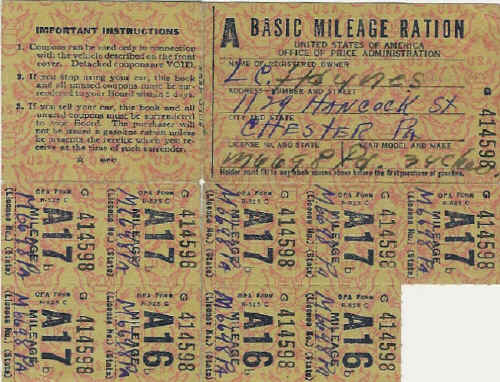
Democrats Propose Gas Stamps

Excerpt:

As the U.S. economy teeters on the brink of recession, Democratic leaders are revisiting an idea born of the Great Depression: gas stamps to help Americans cope with high fuel prices.

The proposal to subsidize fuel costs for lower-income families and individuals would almost certainly be popular with white, working-class voters and could boost Barack Obama’s appeal with that critical voting bloc in this year’s presidential election.

Democratic lawmakers and their leaders say they are serious about including it in a second economic stimulus package expected to move this month. Meanwhile, Republicans ridicule the idea as a return to welfare-state politics, which they say characterized the Democratic Party before Bill Clinton.

“It’s certainly under consideration,” House Majority Leader Steny Hoyer (D-Md.) told The Hill on Thursday afternoon. “It would be like food stamps for those people who need help.”

Gas stamps would work like traditional food stamps, which some Americans have collected since the 1930s. They would be used, however, to pay for regular unleaded instead of meat and potatoes.

Under one version of the proposal, a person earning up to $31,200 or a family of four earning up to $63,600 could receive government payments totaling $500 for gas.


HT: The Truth About Cars

6.14.2008

Global warming frenzy

Global Warming and the Price of a Gallon of Gas

Excerpt:

Through all history, Earth has shifted between two basic climate regimes: ice ages and what paleoclimatologists call “Interglacial periods”. For the past 10 thousand years the Earth has been in an interglacial period. That might well be called nature’s global warming because what happens during an interglacial period is the Earth warms up, the glaciers melt and life flourishes. Clearly from our point of view, an interglacial period is greatly preferred to the deadly rigors of an ice age. Mr. Gore and his crowd would have us believe that the activities of man have overwhelmed nature during this interglacial period and are producing an unprecedented, out of control warming.

Comment: Excellent read

6.09.2008

Lack of investment to blame

BP chief Tony Hayward says lack of investment to blame for oil spike

Excerpt:

"Producers are being hampered by 25 years of low investments, because of low prices," Mr Hayward told the Asia Oil and Gas Conference in Kuala Lumpur today. "The result is a supply chain being stretched to breaking point."

Comment: & speculation & The Fed's strategy

Excerpt:

Zhang dismissed the idea that rising demands in industrializing countries such as China and India should be blamed for the surge of oil prices.

"This is an incomprehensive idea since decisive factors for oil prices have run further beyond the concept of supply and demand," Zhang said in his speech at the energy ministers meeting between India, China, the United States, Japan and South Korea.

Zhang noted that from 2003 to 2006, world oil consumption posed annual increases of 1.9 percent, 3.8 percent, 1.2 percent and 0.7 percent respectively. "The rates were all in normal range."

He suggested that his counterparts put the rising oil prices into the context of global financial market, which could be affected by a wide range of factors such as the change of exchange rates, geopolitics, political instabilities and natural disasters.

"All these may turn to be reasons for speculation, ...and from this way of thinking, an answer to the current record high oil price could be found," Zhang said.


Excerpt (view article for chart):

The Fed's strategy has triggered a dollar rout and commodity boom that has sent food and energy prices soaring. The nearby chart shows how oil prices have risen as interest rates have fallen. This commodity spike has made a recession more likely, not less. The trend is ominous enough that early last week Fed Chairman Ben Bernanke finally dropped his not-so-benign neglect and talked up the dollar; oil prices fell.

6.03.2008

"a structural change, not just a cyclical change"


GM to Close Four Truck Plants, Shift Output to Cars

Excerpt:

Gasoline exceeding $4 a gallon represents ``a structural change, not just a cyclical change,'' Rick Wagoner, chief executive officer of the largest U.S. automaker, told reporters today before its annual shareholders' meeting in Wilmington, Delaware.

The four plant closings will save $1 billion annually and cut North American capacity by 700,000 for trucks and, with added shifts at car factories, by 500,000 overall, he said. At Hummer, ``we're considering all options from a complete revamp to a partial or complete sale of the brand,'' Wagoner said.

A doubling of U.S. gasoline prices since 2004, including a 31 percent surge this year, is forcing Wagoner to accelerate production of more fuel-efficient vehicles as he tries to end three years of losses. Cars will account for 60 percent of Detroit-based GM's North American production in three years, up from about 50 percent now, he said.

``It is significant, but this is a late reaction to changing market dynamics,'' said Dennis Virag, president of Automotive Consulting Group in Ann Arbor, Michigan. ``The plans really should have been in place a number of years ago.''


Comment: When we moved to Plymouth 12 years ago (12 years ago this week!), gas was under $ 1.00 a gallon. Four years ago $ 2.00 per gallon. Now $ 4.00 per gallon. This acceleration of fuel cost increases will force a huge "structural change" on our economy: where we live (closer to work), worship (closer to church), the car we intend to buy the next time. Re cars: I doubt I would buy a 240 HP Impala the next time. Perhaps the next time will be a 4 cylinder Malibu.

More on the "wayback machine". When I started driving (1965) gas was in the 20-25 cent a gallon range.


Hummer & image above from GM to close 4 truck plants, may sell or close HUMMER

Updated (More on this "structural change"): Honda Civic, Toyota Camry and Corolla all outsell Ford F-150 for the first time


Excerpt:

... after 17 years worth of being this country's best-selling vehicle, the Ford F-150 full-size pickup (42,973) has fallen for the first time to fourth place behind the Toyota Camry (51,291), Corolla (52,826) and your new best-selling vehicle in the U.S., the Honda Civic (53,299). Note to automakers: that would be the sound of the canary in your coal mine hitting the floor.

2.03.2008

The $2,500 car and higher gas prices

Cheap cars in Asia, expensive gas everywhere

Excerpt:

The debut of the $2,500 car may be billed as a mobility breakthrough for billions of people in the developing world, but for U.S. motorists it could mean one thing: higher gas prices.


Rising demand from the developing world has long been cited as a main driver behind the runup in oil prices. That demand will only get more intense with staggering growth in car sales - and by extension, gasoline use - in places like India and China.


"We'll get into a situation where we'll have to compete with them for gasoline, $4, $5 a gallon, who knows how high we could go." said Peter Beutel, an oil analyst at the consultancy Cameron Hanover.


He says that time could come much sooner than 2015, when light vehicle sales in India are expected to total over 3 million - doubling 2006 sales - according to J.D. Power & Associates. In China they're expected to nearly triple - to over 17 million - roughly on par with projected sales in the United States.


That huge growth doesn't even begin to scratch the surface of potential car buyers in those countries though. The 2 billion-plus combined populations of India and China could one day dwarf the 300 million potential car buyers in the U.S.


Comment: See The world's cheapest car. Here's the kicker: The U.S.'s appetite for imports drives the very economies that raise the incomes for there car buyers.

1.18.2008

The case against increasing gas taxes

Gas Taxes Are High Enough

Excerpt:

Contrary to the views of the majority of the commission, we do not believe Washington is capable of spending billions more of Americans' money wisely when it comes to transportation investments. Anyone who doubts that should review the more than 6,000 earmarks in the last transportation bill or visit the new Woodstock Museum in upstate New York.

Even if Congress loses its taste for pork, raising gas taxes and spending more on highways still won't improve the quality of Americans' commutes, though it would likely make them more expensive. We tried this already and it simply doesn't work.

Over the past 25 years, the federal government has increased transportation spending by 100%, yet traffic has grown by over 300%. Not surprisingly, recent studies, including one last summer by the Government Accountability Office, have found that higher gas taxes do nothing to improve traffic congestion.

Comment: Secretary of Transportation Peters makes a valid point: can we trust the federal government with more highway revenues? Her case is "no"!

1.06.2008

The End of Sprawl?

Beginning Of The End For Sprawl?

Excerpt:

As the New Urbanist News reported this fall, during the present downturn, accompanied as it has been by high gas prices, homes close to urban centers or that have convenient access to transit seem to be holding their value better than houses in car-dependent communities at the urban edge. A recent story in the Minneapolis Star Tribune blamed flagging growth in the Twin Cities' outer suburbs on rising gas prices. If prices at the pump continue to increase, as many analysts expect, the eventual recovery of demand for new housing may not be accompanied by a resumption of America's relentless march into the cornfields.

The death of sprawl will present enormous challenges, chief among them the need to provide affordable middle-class housing in areas that are already built up. Accommodating a growing population in the era of high gas prices will mean increasing density and mixing land uses to enhance walkability and public transit.

And this must happen not just in urban centers but in existing suburbs, where growth is stymied by parochial and exclusionary zoning laws. Overcoming low-density, single-use zoning mandates so as to fairly allocate the costs of increased density will require coordination at regional levels. This in turn will require overcoming the Balkanization of America's metropolitan areas. This shift toward a more regional outlook will force broad rethinking of how we fund and deliver services provided by local governments, most obviously (and explosively) public education.

Although the end of sprawl will require painful changes, it will also provide a badly needed opportunity to take stock of the car-dependent, privatized society that has evolved over the past 60 years and to begin imagining different ways of living and governing. We may discover that it's not so bad living closer to work, in transit- and pedestrian-friendly, diverse neighborhoods where we run into friends and neighbors as we walk to the store, school or the office.

Comment: Interesting article about how high energy prices may reverse suburban sprawl.

8.03.2007

Republicans for a gas tax increase


Pawlenty Open To Gas Tax Increase After Disaster

The Governor finally came around to my view!

Will a mileage tax replace the gas tax?

Excerpt:

Minnesota, with only five million people, has the fifth-largest highway system in the United States, the Minnesota Department of Transportation says. That's 135,000 miles of roadway and more than 20,000 bridges.


It's too late to debate whether it was a good idea to build all that infrastructure. Advocates say the vast road system makes it relatively easy to move goods and people around and gives the state an economic edge over other areas of the country.


Even people without ties to road and bridge interests say the state is billions behind in keeping up with repair and replacement.

6.17.2007

Aggravating the gasoline supply


Ethanol focus forces oil industry to cut expansion

Excerpt:

A push from Congress and the White House for huge increases in biofuels, such as ethanol, is prompting the oil industry to scale back its plans for refinery expansions. That could keep gasoline prices high, possibly for years to come.

With President Bush calling for a 20 percent drop in gasoline use and the Senate now debating legislation for huge increases in ethanol production, oil companies see growing uncertainty about future gasoline demand and little need to expand refineries or build new ones.

Oil industry executives no longer believe there will be the demand for gasoline over the next decade to warrant the billions of dollars in refinery expansions - as much as 10 percent increase in new refining capacity - they anticipated as recently as a year ago.

Comment: Illustrates the law of unintended consequences!