4.09.2008

A Minnesota state sponsored Muslim school?

Teacher breaks wall of silence at state's Muslim public school

Excerpt:

Evidence suggests, however, that TIZA is an Islamic school, funded by Minnesota taxpayers.

TIZA has many characteristics that suggest a religious school. It shares the headquarters building of the Muslim American Society of Minnesota, whose mission is "establishing Islam in Minnesota." The building also houses a mosque. TIZA's executive director, Asad Zaman, is a Muslim imam, or religious leader, and its sponsor is an organization called Islamic Relief.

Students pray daily, the cafeteria serves halal food - permissible under Islamic law -- and "Islamic Studies" is offered at the end of the school day.

Zaman maintains that TIZA is not a religious school. He declined, however, to allow me to visit the school to see for myself, "due to the hectic schedule for statewide testing." But after I e-mailed him that the Minnesota Department of Education had told me that testing would not begin for several weeks, Zaman did not respond -- even to urgent calls and e-mails seeking comment before my first column on TIZA.

Now, however, an eyewitness has stepped forward. Amanda Getz of Bloomington is a substitute teacher. She worked as a substitute in two fifth-grade classrooms at TIZA on Friday, March 14. Her experience suggests that school-sponsored religious activity plays an integral role at TIZA.

Arriving on a Friday, the Muslim holy day, she says she was told that the day's schedule included a "school assembly" in the gym after lunch.

Before the assembly, she says she was told, her duties would include taking her fifth-grade students to the bathroom, four at a time, to perform "their ritual washing."

Afterward, Getz said, "teachers led the kids into the gym, where a man dressed in white with a white cap, who had been at the school all day," was preparing to lead prayer. Beside him, another man "was prostrating himself in prayer on a carpet as the students entered."

"The prayer I saw was not voluntary," Getz said. "The kids were corralled by adults and required to go to the assembly where prayer occurred."

Islamic Studies was also incorporated into the school day. "When I arrived, I was told 'after school we have Islamic Studies,' and I might have to stay for hall duty," Getz said. "The teachers had written assignments on the blackboard for classes like math and social studies. Islamic Studies was the last one -- the board said the kids were studying the Qu'ran. The students were told to copy it into their planner, along with everything else. That gave me the impression that Islamic Studies was a subject like any other."


Comment: Eye-opening.

Paul Volcker's concern about the "dollar crisis"

Volcker's Demarche

Excerpt:

On the dollar, Mr. Volcker's blunt talk of crisis is a welcome tonic to the devaluationist consensus that now dominates Washington. The world has been staging a run on the greenback, with damaging results if it continues. Mr. Volcker noted that when "concerns about recession are rife," the central bank will be tempted to "subordinate the fundamental need to maintain a reliable currency" to the impulse to shore up a flagging economy. The danger is that you lose both battles, as the U.S. did in the 1970s, and wind up with stagflation.

The present climate, Mr. Volcker told his audience, reminded him of nothing so much as the early 1970s. Then as now, certain commodity prices were rising fast – he cited oil and soybeans as two examples. Then as now too, these were explained away as speculative price run-ups and not as a harbinger of a broader inflationary trend.

We all know how that ended, and Mr. Volcker knows better than anyone. He was the one who, at the end of that decade, had to step in and raise interest rates to punitive levels to break the back of that bout of inflation. With commodity prices spiking again – soybeans are $12 a bushel today compared to $7 a year ago – Mr. Volcker is warning the Fed not to let inflationary expectations become embedded once again.


Comment: Note bolded red above

Good questions for Obama re Wright

Obama's Minister Problem

The Quotes:

- "We bombed Hiroshima, we bombed Nagasaki, and we nuked far more than the thousands in New York and the Pentagon, and we never batted an eye. We have supported state terrorism against the Palestinians and black South Africans, and now we are indignant because the stuff we have done overseas is now brought right back to our own front yards. America's chickens are coming home to roost."
-- Sept. 16, 2001 (the first Sunday after 9/11)

- "The government . . . wants us to sing God Bless America. No, no, no. God damn America; that's in the bible, for killing innocent people. God damn America for treating our citizens as less than human."
-- 2003

- "The United States of White America."
-- July 22, 2007


The Questions:

Why did he stay a member of the congregation? Why didn't he speak up earlier? And why did he reward Rev. Wright with a campaign position even after knowing of his comments?

4.08.2008

"when the tide goes out, you see who is not wearing their bathing suit"

Citigroup, Wells Fargo May Loan Less After Downgrades

Excerpt:

Bank holding companies including Citigroup Inc., Bank of America Corp. and Wells Fargo & Co. have the thinnest safety cushion against losses in seven years.

The margin may erode further in coming weeks. Credit ratings on $704 billion of bonds have been cut this year following the collapse of the U.S. housing market. Sheila Bair, chairman of the Federal Deposit Insurance Corp., said last week that the downgrades may compromise bank capital ratios enough that some of the largest institutions will no longer be considered well capitalized.

Falling below a regulatory benchmark that is intended to maintain a minimum level of capital to protect depositors against losses would subject banks to more scrutiny from regulators than they have ever experienced.

``This is a nightmare for the country,'' said William Isaac, who was chairman of the FDIC from 1981 to 1985. Banks will ``raise what capital they can, then they'll slow down their growth and stop lending, and what should be a mild recession becomes a much more serious one.''

The biggest danger to the economy is that to preserve their ratios, banks will cut off the flow of credit, causing a decline in loans to companies and consumers. Banks have already raised $136 billion in capital, based on data compiled by Bloomberg, and cut dividends. More stock sales and payout reductions are likely to follow, says analyst Meredith Whitney at Oppenheimer & Co.


Comment: Bank accounting is murky to me ... but this article is about capital ratios.

Thinking about "blameless"

Our church is in the midst of the Pastoral candidate process. This past Sunday, our prospective Senior Pastor answered questions for an hour. Many were very tough. One question pertained to the capstone qualification of the Bishop, "blameless".

Scripture: 1 Timothy 3:2, "A bishop then must be blameless, the husband of one wife, temperate, sober-minded, of good behavior, hospitable, able to teach"

The Greek adjective (ἀνεπίλημπτος) is used just three times in the New Testament, all in 1 Timothy: usage. The meaning is basically this: "blameless, unrebukeable"

4.07.2008

West Wing: Four Days in Denver

Four Days in Denver

Comment: Language alert! But a good read!

Salon: Why Hillary Clinton should be winning

Why Hillary Clinton should be winning

Excerpt: (Too long to excerpt)

Comment: Salon's points: Hillary has better chance against McCain ... and the Dem's system is crazy!

Conclusion:

In the final analysis, though, the fights inside the Democratic Party aren't really about either an ideal American democracy or the American democracy that actually exists. According to the Obama campaign, democracy is defined as whatever helps Barack Obama win the Democratic nomination. There is nothing intrinsically wrong with a candidate arguing this way. But everybody should see it for what it is -- not something new or transformative, but one of the oldest ploys in the playbook of American politics.

An Absolut fence


Absolut campaign depicted southwestern U.S. as part of Mexico

Excerpt:

The Absolut vodka company apologized Saturday for an ad campaign depicting the southwestern U.S. as part of Mexico amid angry calls for a boycott by U.S. consumers.

The campaign, which promotes ideal scenarios under the slogan "In an Absolut World," showed a 1830s-era map when Mexico included California, Texas and other southwestern states. Mexico still resents losing that territory in the 1848 Mexican-American War and the fight for Texas independence.


HT: LaTimes Blogs

4.06.2008

Not-fast food


Building better burger at Rube Goldberg contest

Excerpt:

This year's task was to assemble a burger consisting of no less than one precooked meat patty, two vegetables and two condiments, sandwiched between bun halves.

The victory by the 17-member Purdue Society of Professional Engineers was the team's third such win in the past four years in the contest, named for the late cartoonist known for his drawings of complicated devices performing simple tasks.

Texas A&M University placed second; the University at Buffalo in New York was third.

After winning the regional contest in February, Purdue's team added 55 steps to perfect its machine, captain Drew Wischer said.

"We put 4,000 to 5,000 man-hours into this machine since September, and all the hard work has been well worth it," said Wischer, a senior in aviation technology from Cedarburg, Wis.

Comment: Interesting

Jesus at the wheel of a '66 Mustang

Bow your heads: Kansas man forming Mustang Church of America

Excerpt:

An idea popped into Charles' head last summer, and The Mustang Church of America and Museum was born. It's even got its own logo: the Christian fish symbol with the running pony inside.

Built next to the house in which he was born, the facility is set to open later this summer and will display Mr. Ales' collection of Mustangs. He also plans to host car shows, swap meets and two Mustang blessings a year. Charles and his adopted son Robert Brunch, both ordained ministers, will preside over Sunday services in the non-denominational church. "I'll preach goodness and helping my fellow humankind. I'll preach what we're supposed to do - make this a better world than we found it," he told the local Pittsburg, KS Morning Sun newspaper.

The mural behind his pulpit will show Jesus at the wheel of a '66 Mustang. Bet you don't have one of those at your church.

Comment: Speechless. Full article here. More:

Ales is planning a unique mural for the wall behind his pulpit.

"It shows Jesus at the wheel of a 1966 Mustang," he said. "It's being done on a metal plate at Patterson's Artworks."

He's also had T-shirts printed up with the same theme. His church logo, developed by Matt Wilbert, is a fish, a traditional Christian symbol, with a Mustang horse inside.

"Somebody asked me if I wasn't worried about people thinking this was sacrilegious," Ales said. "Well, I hope Jesus has a sense of humor."

He and Brunch are both ordained through the Universal Ministry School of Theology.

4.05.2008

The stresses of blogging

In Web World of 24/7 Stress, Writers Blog Till They Drop

Excerpt:

Of course, the bloggers can work elsewhere, and they profess a love of the nonstop action and perhaps the chance to create a global media outlet without a major up-front investment. At the same time, some are starting to wonder if something has gone very wrong. In the last few months, two among their ranks have died suddenly.

Two weeks ago in North Lauderdale, Fla., funeral services were held for Russell Shaw, a prolific blogger on technology subjects who died at 60 of a heart attack. In December, another tech blogger, Marc Orchant, died at 50 of a massive coronary. A third, Om Malik, 41, survived a heart attack in December.

Other bloggers complain of weight loss or gain, sleep disorders, exhaustion and other maladies born of the nonstop strain of producing for a news and information cycle that is as always-on as the Internet.

To be sure, there is no official diagnosis of death by blogging, and the premature demise of two people obviously does not qualify as an epidemic. There is also no certainty that the stress of the work contributed to their deaths. But friends and family of the deceased, and fellow information workers, say those deaths have them thinking about the dangers of their work style.

Comment: I am sooooo stressed!

Anti-consumerism in Florida

A Ban on Allstate Upheld in Florida

Excerpt:

A Florida appeals court on Friday upheld a state regulator’s order suspending the Allstate Corporation from writing new insurance policies in Florida.

The Florida insurance commissioner, Kevin M. McCarty, said that Allstate had 15 days to appeal and that he was not sure when the suspension would take effect.

Allstate said it was reviewing the ruling, issued by the First District Court of Appeal in Tallahassee, but believed it was not yet final. Allstate said it would continue to write new business.

“We are very disappointed in today’s ruling and disagree with the court’s opinion,” Allstate said Friday.

The suspension would mainly affect new auto policies, because Allstate said previously it planned to reduce its homeowner policy exposure in Florida.

Comment: And how does this help the consumer?

Another Hillary lie!

Ohio Hospital Contests a Story Clinton Tells

The Lie:

Over the last five weeks, Senator Hillary Rodham Clinton of New York has featured in her campaign stump speeches the story of a health care horror: an uninsured pregnant woman who lost her baby and died herself after being denied care by an Ohio hospital because she could not come up with a $100 fee.

...
The Truth:


The woman, Trina Bachtel, did die last August, two weeks after her baby boy was stillborn at O’Bleness Memorial Hospital in Athens, Ohio. But hospital administrators said Friday that Ms. Bachtel was under the care of an obstetrics practice affiliated with the hospital, that she was never refused treatment and that she was, in fact, insured.

“We implore the Clinton campaign to immediately desist from repeating this story,” said Rick Castrop, chief executive officer of the O’Bleness Health System.

Linda M. Weiss, a spokeswoman for the not-for-profit hospital, said the Clinton campaign had never contacted the hospital to check the accuracy of the story, which Mrs. Clinton had first heard from a Meigs County, Ohio, sheriff’s deputy in late February.


Comment: Won't these people (the Clintons) ever stop?!

4.04.2008

Obama's miscalculation on capital gains

Obama's Capital Loss

Excerpts:

In 1986, the tax rate jumped to 28% from 20%, a 40% increase. Tax revenues spiked briefly in anticipation of the hike (as investors moved to cash in at the lower rate), then dropped precipitously. Four years later, in 1990, the federal government was still taking in 13% less revenue at the 28% rate than it did in 1985 at the 20% rate.

As for Mr. Obama's implication that capital gains remain the privilege of the wealthy well, that's yesterday. In recent decades, the U.S. has become a shareholder society, and average Americans increasingly rely on investment income to save for retirement or even to pay bills.

...
With the economy weak, this is an especially poor time to be talking up tax hikes. A higher rate, and its devaluing of U.S. assets, would hammer U.S. competitiveness, making it harder to attract global capital. America is increasingly isolated in taxing capital gains. Many industrialized competitors publicize a lower rate, and many (Germany, Switzerland, Austria, New Zealand) have no levy at all.

If Mr. Obama really wants to lift the economy – and those middle-class American shareholders – he'd advocate cutting the rate, or indexing it to inflation so investors aren't taxed on phantom gains. That would violate the Democratic left's faith that tax rates don't matter to growth and that raising taxes on capital and "the rich" is good politics. We doubt members of America's politically astute investor class agree.

Comment: Cf Hoover's heirs?

Who are Hoover's heirs?

Hoover's Heirs

Excerpt:

To hear Mr. Schumer and his fellow-traveling columnists tell it, Hoover's great policy blunder was to do nothing, all the while insisting that everything was fine. But the problem with Hoover's economic policy isn't that it was passive but that it was actively destructive.

In 1930, he signed the Smoot-Hawley Tariff Act, setting off a wave of protectionist retaliation that undid the globalization of the preceding decades and did far more harm to the world economy than the stock-market crash ever did. Two years later, amid a bad recession, he undid the Calvin Coolidge-Andrew Mellon tax cuts, raising the top marginal income-tax rate to 63% from 25%. The recession became a Depression.

Comment: It's the Dems who want to raise taxes and dismiss free trade!

Ready for 50mpg cars? Think again

Why automakers don't sell a car that gets 50mpg

Excerpts:

Consider the exercise Ford just went through. It ran a computer simulation on what would happen to the mileage of a Ford Focus small car if you built it entirely out of lightweight aluminum. Losing the steel allowed the Focus to drop 1,000 pounds—30 percent of its body weight. That enabled Ford to outfit it with a tiny one-liter engine, half the size of its old engine, but far more fuel efficient because of new technology. Best of all, the small motor goes just as fast as the big one because the car is so much lighter. The result: fuel economy on this fabulous Focus went from 35mpg to 50mpg. What's stopping Ford from moving this car from pixels to pavement? The cost of an all-aluminum car could top $50,000—not a sum the typical economy-car buyer is willing to pay. "What's going to be the cost acceptance for this much improvement in fuel economy?" asks Dan Kapp, director of Ford's advanced engines and transmissions. "We don't know yet."

Still, all the major automakers are putting their cars on a crash diet. Ford wants to drop 250 to 750 pounds in all its models by 2012. Toyota and Nissan want to cut the fat by 10 to 15 percent. But this slim-fast campaign is running into the drive for more safety features in automobiles. Back in the 1980s, the Honda CRX-HF and the Geo Metro each got more than 50mpg, but they didn't have airbags or steel beams in their doors to protect occupants in a crash.


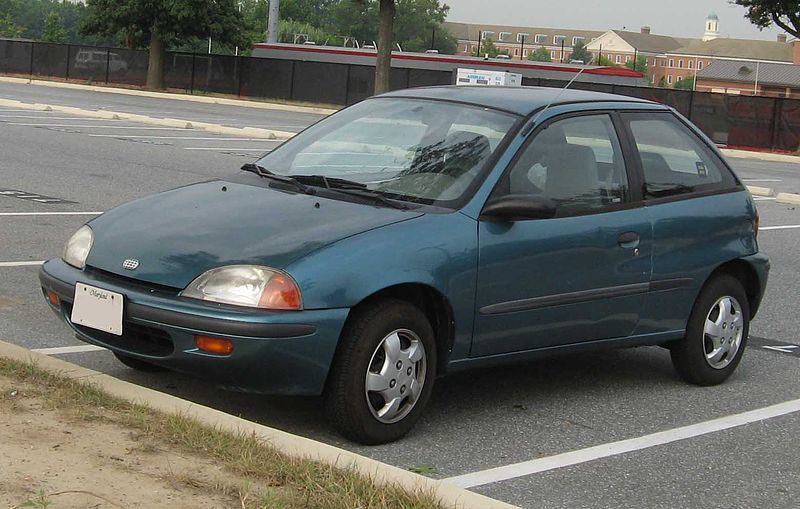
Comment: I used to have a '95 Geo Metro (like picture below). I used it for Pastoral visitation. It did not have A/C, was a 5 speed transmission, and a 3 cylinder engine. This car was fun to drive ... but my one "long" trip from Denver to Pueblo Colorado (120 miles) was seriously hard on one's backside and back!


Boyfriend 5.0 to Husband 1.0

Dear Tech Support,

Last year I upgraded from Boyfriend 5.0 to Husband 1.0 and noticed a distinct slow down in overall system performance -- particularly in the flower and jewelry applications, which operated flawlessly under Boyfriend 5.0.

In addition, Husband 1.0 uninstalled many other valuable programs, such as Romance 9.5, Personal Attention 6.5, and Candy 4.0 and then installed undesirable programs such as NFL 5.0, NBA 3.0, and Golf Clubs 4.1.

Conversation 8.0 no longer runs, and Housecleaning 2.6 simply crashes the system. I've tried running Nagging 5.3 to fix these problems, but to no avail. What can I do?

Signed,

Desperate


Dear Desperate:

First keep in mind, Boyfriend 5.0 is an Entertainment Package, while Husband 1.0 is an Operating System.

Please enter the command: 'I Thought You Loved Me.exe', try to download Tears 6.2 and don't forget to install the Guilt 3.0 update. If that application works as designed, Husband 1.0 should then automatically run the applications Jewelry 2.0 and Flowers 3.5. But remember, overuse of the above application can cause Husband 1.0 to default to Grumpy Silence 2.5, Happy Hour 7.0 or Beer 6.1. Beer 6.1 is a very bad program that will download the Snoring Loudly Beta.

Whatever you do, DO NOT install Mother-in-law 1.0 It runs a virus in the background that will eventually seize control of all your system resources. Also, do not attempt to reinstall the Boyfriend 5.0 program. These are unsupported applications and will crash Husband 1.0

In summary, Husband 1.0 is a great program, but it does have limited memory and cannot learn new applications quickly. You might consider buying additional software to improve memory and performance. We recommend Food 3.0 and Hot Lingerie 7.7.


Comment: From my daughter

4.03.2008

Foreclosures hinder job transfers


Unsold Homes Tie Down Would-Be Transplants

Excerpt:

The rapid decline in housing prices is distorting the normal workings of the American labor market. Mobility opens up job opportunities, allowing workers to go where they are most needed. When housing is not an obstacle, more than five million men and women, nearly 4 percent of the nation’s work force, move annually from one place to another — to a new job after a layoff, or to higher-paying work, or to the next rung in a career, often the goal of a corporate transfer. Or people seek, as in Dr. Morgan’s case, an escape from harsh northern winters.

Now that mobility is increasingly restricted. Unable to sell their homes easily and move on, tens of thousands of people like Mr. Kirkland and Dr. Morgan are making the labor force less flexible just as a weakening economy puts pressure on workers to move to wherever companies are still hiring.

Signaling an incipient recession, nearly 85,000 jobs disappeared in the United States from December through February, and the Bureau of Labor Statistics is expected to announce on Friday that March failed to produce a turnaround in hiring.


More:

Mortgage defaults force Denver exodus

Excerpt:

For hundreds of homeowners in this mostly middle-class corner of Denver — and an estimated 1.2 million more nationwide — the wave of foreclosures battering U.S. financial markets is quickly unraveling the American dream. Those who have lost homes here describe seeing their lives crumble into anxiety and embarrassment. Many leave for cheap apartments or rooms with relatives, a trend that is tightening the market for affordable housing.

This small corner of the Mile High City represents an extreme example of how foreclosures are transforming lives and neighborhoods. On some blocks, as many as one-third of the residents have lost their homes, making this one of the worst hotspots in a city that was among the first to feel the pinch of the foreclosure crisis. Many houses here remain empty, bank lockboxes on the front doors.

The foreclosure epidemic has swept so quickly through this part of Denver that in less than two years, lenders took action on 919 of the roughly 8,000 properties here, according to city records. Their owners defaulted on more than $171 million in mortgages they had used to buy their way out of apartments and into cul-de-sacs. Many were buying homes for the first time, in what seemed the most affordable of the city's new subdivisions. They paid their way with easy credit — sometimes secured from aggressive lenders who appeared to look past the checkered credit histories and unstable jobs of some of their customers. Ultimately, many of the buyers couldn't afford their mortgages.


Comment: Interactive map of Green Vally Ranch subdivision (2nd article)

a candidate for child-abuse charges or letting kids have their independence?


Here's Your MetroCard, Kid

Intro:

I left my 9-year-old at Bloomingdale's (the original one) a couple weeks ago. Last seen, he was in first floor handbags as I sashayed out the door.

Bye-bye! Have fun!

And he did. He came home on the subway and bus by himself.

Was I worried? Yes, a tinge. But it didn't strike me as that daring, either. Isn't New York as safe now as it was in 1963? It's not like we're living in downtown Baghdad.

Anyway, for weeks my boy had been begging for me to please leave him somewhere, anywhere, and let him try to figure out how to get home on his own. So on that sunny Sunday I gave him a subway map, a MetroCard, a $20 bill, and several quarters, just in case he had to make a call.

No, I did not give him a cell phone. Didn't want to lose it. And no, I didn't trail him, like a mommy private eye. I trusted him to figure out that he should take the Lexington Avenue subway down, and the 34th Street crosstown bus home. If he couldn't do that, I trusted him to ask a stranger. And then I even trusted that stranger not to think, "Gee, I was about to catch my train home, but now I think I'll abduct this adorable child instead."

Long story short: My son got home, ecstatic with independence.


Comments: Featured on The Today Show. Trust me I know they were "different times" and a different place: Growing up in Fort Wayne Indiana (1950's), we used take the bus all over town (the bus ride was a dime). We used to do endless exploring with "bike-hikes" in the Summer. Mom would pack a lunch and off we would go. Once we sent our middle son on a bike adventure in Denver. He called after about 3 hours and providing the cross streets said "where am I?". After that checkpoint he made it home OK. I actually applaud this woman for her willingness to let her son explore! Beat me up!

Government: punishing prudence and rewarding irresponsibility

Uncle Subprime

Excerpts:

Mr. Frank's idea is that, for mortgages originated between the start of 2005 and mid-2007, a lender and borrower would be able to agree on a federal refinancing plan. Lenders would have to write down their loan to no more than 85% of the current appraised value of the property – which means the banks will use this opportunity to unload the biggest stinkers in their loan portfolios.

For the borrower, the deal is even sweeter: a low fixed monthly payment and a reduction in the principal to market value. The Federal Housing Administration would then guarantee the loan, up to a total of $300 billion in total Frank Refis. The deal is so sweet that even Mr. Frank is concerned that otherwise reliable borrowers may "purposely default" to be eligible for assistance. His solution is to require borrowers to "certify" that they really, truly aren't doing this simply to get on the taxpayer gravy train.

...
In sum, Mr. Frank is volunteering U.S. taxpayers to insure $300 billion in mortgages with underwriting standards to be named later. Connecticut Senator Chris Dodd thinks $400 billion is more like it. Quavering Republicans should do the political math. The Mortgage Bankers Association tracks 46 million mortgage borrowers, and 42 million are paying on time. More than 20 million households own their homes outright and, having worked for years to pay for them, probably don't want to pay for someone else's. Neither do 35 million renters who didn't take a flyer on nicer digs.


Robert J. Samuelson: How Not to Save Housing

Excerpts:

No reasonable person takes pleasure from seeing people lose their homes, and Congress is understandably upset. Estimates of defaults in 2008 run up to 2 million. If realized, that would be roughly twice the 2006 level and about 2.7 percent of the nation's 75 million owner-occupied homes. It would be the highest rate since World War II but well below much higher rates during the Great Depression, says economist Kenneth Snowden of the University of North Carolina at Greensboro.

The best-known congressional proposal comes from Massachusetts Rep. Barney Frank, chairman of the House Financial Services Committee. (The Bush administration is reportedly considering a similar plan.) Frank's plan would authorize the Federal Housing Administration to guarantee $300 billion of new home loans to strapped homeowners, allowing them to refinance their mortgages at lower rates and reduce outstanding amounts. Under the plan homeowners who borrowed between Jan. 1, 2005, and July 1, 2007, would be eligible for new loans if their monthly payments of interest and principal exceeded 40 percent of their income—well above a more prudent level of 30 percent.

...
Everyone wins from this arrangement, say its supporters. Homeowners—some of the victims of deceptive lending—stay in their houses. Neighborhoods don't suffer the potential blight of numerous foreclosures. Housing prices don't go into a free fall, depressed by an avalanche of foreclosures. Although lenders take a loss, the losses are lower than they would be if homes went into foreclosure. That's a costly and lengthy process that can involve losses of 50 percent or more.

The Frank proposal and others like it put politicians on the barricades, trying to protect needy homeowners. The imagery is flattering. But there are two glaring problems, one moral, the other economic.

About 50 million homeowners have mortgages. Who wouldn't like the government to cut their monthly payments by 20 or 30 percent? But Frank's plan reserves that privilege for an estimated 1 million to 2 million homeowners who are the weakest and most careless borrowers. With the FHA now authorized to lend up to $729,750 in high-cost areas, some beneficiaries could be fairly wealthy. By contrast, people who made larger down payments or kept their monthly payments at manageable levels would be made relatively worse off. Government punishes prudence and rewards irresponsibility. Inevitably, there would be resentment and pressures to extend relief to other "needy" homeowners.


Comment: Every parent knows that sometimes one can be "too good" to children. Examples would be shielding them from financial realities to the point that they do not learn to be fiscally responsible adults. It's also possible for government to be "too good" to the point that it "punishes prudence and rewards irresponsibility". These 2 articles highlight that danger.