Showing posts with label Retirement Countdown. Show all posts

10.11.2014

Cash Balance Plan: The Annuity Option


Cash balance retirement plans: Annuity options
Excerpt:


If you're retiring from a company with a cash balance retirement plan, take the time to analyze your payout options. While many people take a lump sum payout, the annuity option might be best for you. ... So when you retire, should you take your account and roll it over to another type of account that could generate a monthly income for you, such as an IRA or annuity, or should you elect to have the plan pay you the monthly annuity? One way to come up with the best answer to this question is to compare the monthly income you would get from your employer's cash balance plan to the annuity income you'd get if you took the lump sum payout and bought an annuity from an insurance company. IRS rules specify the minimum requirements for converting cash balance accounts to an annuity; these minimum conversion rates are usually more favorable to you than the annuity purchase rates you could get if you buy the annuity on your own. And some employers go beyond the minimum requirements and offer even better deals on the annuity. ... Note that a cash balance plan pays the same amount for a man or a woman, due to federal laws that prohibit sex discrimination in employer-sponsored plans. On the other hand, an insurance company is allowed to pay a smaller retirement income to a woman because they expect a woman to live longer than a man
Comment: Website with a quick annuity quote: www.immediateannuities.com.  The annuity quotes from our work cash balance plan system beat the quotes from this site. We may take the annuity option because it is guaranteed money vs the risks of the stock market (rolling into an IRA and investing it). If we live a long time the annuity is a better option .. if we die shortly after retirement it is not. And of course as this article reminds, one never knows. Or as the Scriptures say: "you do not know what will happen tomorrow. For what is your life? It is even a vapor that appears for a little time and then vanishes away." (James 4:14)

10.07.2014

Retirement Checklist


8 Things You Must Do Before You Retire

Excerpt:


  1. Dial back on stocks now
  2. Raise cash
  3. Set a realistic retirement budget
  4. Play out Social Security scenarios
  5. Figure out how you’ll pay for health care
  6. Begin the rollover process
  7. Sign up for Medicare
  8. Get a running start
Comment: Link above is to a helpful article in Money magazine this month. As for us we are approximately 18 months out (one never knows - James 4:15, "instead, you ought to say, "If the Lord wills, we will live and also do this or that."). But one has to plan and then commit oneself to the Lord.

What we are doing:
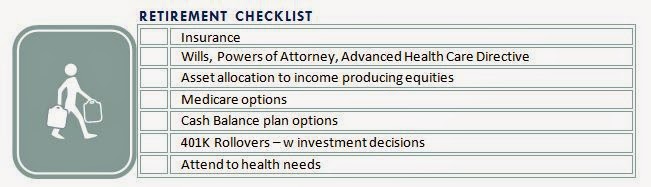
  • This past month I completed a thorough insurance review and changed insurance carriers to a lower cost option with higher benefits (eg the house coverage goes up $ 33,000 and the umbrella coverage goes up another $ 1M)
  • Later this month we will be having the wills redone. The last wills (one is needed for both husband and wife) were done with an CD based product about 15 years ago. And we have never had health care directives or powers of attorney set up.
  • I've investigated our cash balance plan options and we made a decision about how to handle those (the options are either take annuities with guaranteed payouts or roll over the monies into IRAs)
  • Also I have been researching Medicare. (this is complex)
  • We have decided to postpone the planned move into a condominium for at least two years. Our house is in good shape. We agreed that if the snow plowing becomes onerous that we will hire that out. I am planning on plowing this winter and the plow will be put on the last Friday of this month
  • We have older siblings who have tread this path before and they are resources for us with regard to medicare and investment options.

6.23.2014

The best time to begin taking Social Security


At what age should you start claiming Social Security?

Excerpt:

"Most people take it at 62," he says. "They end up losing in the long run. If they delay it till 70, they will get 30% more. Unfortunately," he says, "most Americans can't do that." Improper timing can cost you $100,000 to $150,000 over a lifetime, says John Gajkowski, of Money Managers Financial Group in Chicago. When should you take it? If you delay taking Social Security, it increases your monthly benefit about 8% a year until you're eligible for the maximum at 70. Most financial planners pretty much recommend that you do that if you can, or delay at least until age 66. But most people can't delay.
Comment: Obviously we have not taken it at 62. Kathee is 63 and I am 65. Image of "gramps": "(1939). poster of old man smoking pipe. This poster announces the passage of the 1939 Social Security Amendments." Source. (many cool retro posters here!)

What You Don't Know About Social Security—but Should - A Look at Claiming Strategies, Tax Angles and More to Help You Make Sense of a Complicated Program

Excerpt:


You may have heard the advice countless times: Minimize (or avoid) withdrawals from your nest egg (401(k), individual retirement accounts, etc.) for as long as possible to take advantage of tax-deferred growth. Many investors who follow that advice grab Social Security benefits, typically at age 62, to help pay the bills. But that advice ignores the possible tax benefits associated with following the opposite course: accelerating withdrawals from savings early in retirement so that you can hold off on claiming Social Security. The thinking here is tied to the fact that Social Security benefits are taxable. As much as 85% of a married couple's benefits are subject to tax when their income exceeds $44,000 ($34,000 for individuals); as much as 50% of benefits are taxable at lower income levels. If you delay claiming Social Security and, as a result, end up with larger benefits, future withdrawals from savings will likely be smaller—a recipe for lower levels of taxable income. (For a detailed discussion of these tax issues, see "Innovative Strategies to Help Maximize Social Security Benefits," from James Mahaney, vice president at Prudential Financial Inc. "Many retirees don't consider the impact of their withdrawal strategy on how their Social Security is taxed," says Mr. Meyer, the SocialSecuritySolutions.com founder. "Missteps in tapping the wrong account and investments to generate income can significantly increase your taxes."
Helpful 16 page guide from Prudential: INNOVATIVE STRATEGIES TO HELP MAXIMIZE SOCIAL SECURITY BENEFITS


93