Showing posts with label Ebola. Show all posts

10.26.2014

Ebola, Quarantines, and Constitutional Rights
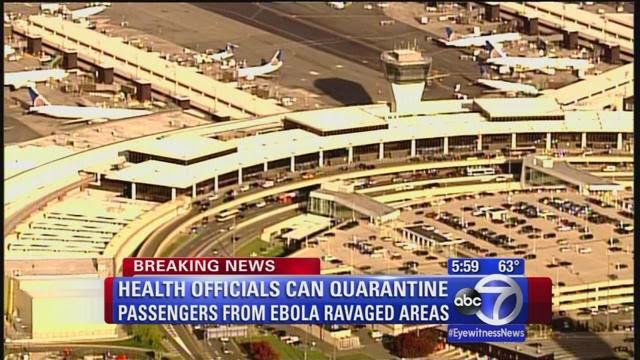


NY, NJ order Ebola quarantine for doctors, others
Excerpt:


Alarmed by the case of an Ebola-infected New York doctor, the governors of New Jersey and New York on Friday ordered a mandatory, 21-day quarantine of all medical workers and other arriving airline passengers who have had contact with victims of the deadly disease in West Africa. The first person to fall under the order was a health care worker returning Friday from treating Ebola patients in West Africa. By Friday evening, she had developed a fever and was being evaluated, New Jersey officials said.
Nurse Detained in New Jersey for Ebola Calls Conditions ‘Really Inhumane’ - Kaci Hickox to Challenge Quarantine; Still Shows No Ebola Symptoms Excerpt:


The nurse detained in New Jersey after treating Ebola patients in Sierra Leone has retained lawyers to challenge a mandatory quarantine in a hospital where she said Sunday the conditions are “really inhumane.” Norman Siegel, a prominent civil rights attorney in New York City, said he planned to file a lawsuit to lift the order keeping Kaci Hickox, a 33-year-old Doctors Without Borders nurse, under quarantine.
Christie Defends Mandatory Ebola Quarantine for Health-Care Workers Excerpt:


New Jersey Gov. Chris Christie on Sunday stood by a decision to impose a mandatory 21-day quarantine for health-care workers returning from treating Ebola patients in West Africa, while a top health-care official said the move wasn’t justified by science. New Jersey is one of four states that have instituted quarantines for travelers who have had contact with Ebola patients in West Africa—measures that go beyond enhanced protocols the federal government has endorsed. “I absolutely have no second thoughts about it,” Mr. Christie said on Fox News Sunday.
Comment: Interesting. I agree with the decision to quarantine. Image source


10.18.2014

Ebola: World "in the eye of a storm" ... "disaster of our generation"


Ebola is 'disaster of our generation' says aid agency

Excerpt:

Aid agency Oxfam on Saturday said Ebola could become the "definitive humanitarian disaster of our generation", as US President Barack Obama urged against "hysteria" in the face of the growing crisis. Oxfam, which works in the two worst-hit countries -- Liberia and Sierra Leone -- called for more troops, funding and medical staff to be sent to tackle the west African epicentre of the epidemic. Chief executive Mark Goldring warned that the world was "in the eye of a storm". "We cannot allow Ebola to immobilise us in fear, but... countries that have failed to commit troops, doctors and enough funding are in danger of costing lives," he said. The worst-ever outbreak of the deadly virus has so far killed more than 4,500 people, mainly in Guinea, Liberia and Sierra Leone, but isolated cases have now begun to appear in Europe and the United States. "The Ebola crisis could become the definitive humanitarian disaster of our generation," a spokesperson for the British-based charity said as it appealed for EU foreign ministers meeting in Luxembourg on Monday to do more.
Comment: Image source

Ebola's "super-spreader" event infected 14 women at a funeral


Outbreak in Sierra Leone Is Tied to Single Funeral Where 14 Women Were Infected

Excerpt:

Sierra Leone’s explosion of Ebola cases in early summer appears to stem from one traditional healer’s funeral at which 14 women were infected, according to scientists studying the blood of victims. The funeral, which took place in mid-May, constitutes a “super-spreader” event comparable to one in 2003 in a Hong Kong hotel in which one doctor from China dying of SARS infected nine other guests who spread the virus throughout the city and to Vietnam and Canada. The funeral was in Koindu, a diamond-mining town across the border from Guéckédou in Guinea, where the outbreak is thought to have begun in December, and the healer was known for treating victims of a mysterious illness that turned out to be Ebola. The funeral’s central role, which local doctors had anecdotally suspected, was confirmed by geneticists at the Broad Institute of M.I.T. and Harvard who sequenced the virus found in 78 patients treated at Kenema Government Hospital in northeastern Sierra Leone, near the borders with Liberia and Guinea, two countries that are also at the heart of the outbreak.  ... “It’s frightening that a single event could catalyze a whole outbreak, but that’s what it looks like happened,” said Dr. W. Ian Lipkin, a renowned virus hunter at Columbia University, who called the study “a really nice piece of work.” The scientists not only found that all 78 had virus traceable to funeral guests, but also showed that the West African Ebola strain was quite different from a strain that has been circulating thousands of miles away in Central Africa since 1976, and that the two probably diverged as far back as 2004.
Comment: Image source. Information on Koindu Sierra Leone

10.17.2014

Imagine the Ebola-as-weapon scenario


Six Reasons to Panic

Excerpt:

Do you really want to be scared? What’s to stop a jihadist from going to Liberia, getting himself infected, and then flying to New York and riding the subway until he keels over? This is just the biological warfare version of a suicide bomb. Can you imagine the consequences if someone with Ebola vomited in a New York City subway car? A flight from Roberts International in Monrovia to JFK in New York is less than $2,000, meaning that the planning and infrastructure needed for such an attack is relatively trivial. This scenario may be highly unlikely. But so were the September 11 attacks and the Richard Reid attempted shoe bombing, both of which resulted in the creation of a permanent security apparatus around airports. We take drastic precautions all the time, if the potential losses are serious enough, so long as officials are paying attention to the threat.
Comment: Image source. We should shut down all travel from West Africa.
See Boehner: Ban Flights From West Africa to Stop Ebola Spread

10.06.2014

The Ebola Virus: How it was discovered and how it was named


'In 1976 I discovered Ebola - now I fear an unimaginable tragedy'
Excerpts:


We had no idea how dangerous the virus was. And there were no high-security labs in Belgium. We just wore our white lab coats and protective gloves. When we opened the Thermos, the ice inside had largely melted and one of the vials had broken. Blood and glass shards were floating in the ice water. We fished the other, intact, test tube out of the slop and began examining the blood for pathogens, using the methods that were standard at the time.

... Why Ebola? On that day our team sat together late into the night – we had also had a couple of drinks – discussing the question. We definitely didn't want to name the new pathogen "Yambuku virus", because that would have stigmatised the place forever. There was a map hanging on the wall and our American team leader suggested looking for the nearest river and giving the virus its name. It was the Ebola river. So by around three or four in the morning we had found a name. But the map was small and inexact. We only learned later that the nearest river was actually a different one. But Ebola is a nice name, isn't it?
Comment: Image source: Captured from the article via a screen shot. Wiki on the Ebola river.

7.29.2014

Ebola Virus in US? Possible but Not Probable


Ebola’s Escape From Africa Unlikely Though Not Impossible

Excerpt:
Ebola, the killer of more than 670 people in four West African countries since February, has spread beyond Africa only once. That doesn’t mean it can’t happen now, infectious disease experts warn. The symptoms appear from two days to three weeks after infection, meaning it’s possible for an infected person who doesn’t feel ill to board a plane, said Ben Neuman, a virologist at the University of Reading in the U.K. Since Ebola in its earliest stages can resemble nothing more than flu, no one else would know either, he said. “One person per plane load would have something that you would possibly call flu-like symptoms,” Neuman said in a telephone interview. “Do you want to detain all those people coming into your airport? Do you have the manpower to do that, and send them all for testing? It’s expensive, and difficult.”

... Ebola virus isn’t carried in the air like tuberculosis or flu, said David Heymann, a professor at the London School of Hygiene and Tropical Medicine. Instead it is spread by direct contact with an infected person’s blood or other bodily secretions, including vomit, saliva or feces, he said. While an infected person who sneezes or coughs directly in another person’s face could infect that person, Ebola primarily enters the body through tiny cuts or abrasions, or through mucus membranes of the eyes, nose, ears and mouth. The physical effect of the virus makes it less likely to spread through air travel, Neuman said. “If you look at the numbers, there are probably about 300 people currently infected with Ebola virus, and most of those would be too ill to sit up or walk,” Neuman said. “So the odds are small, but it is something that needs to be watched.”
Comment: Image source